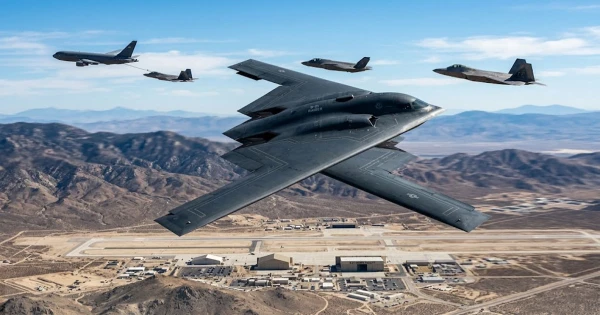
The B-21 Raider—the U.S. Air Force’s next-generation stealth bomber—is moving from prototype tests into scaled flight and training work that will define America’s long-range strike posture for decades, with advances in stealth design, digital systems and sustainment that make it more adaptable than previous bombers and better suited for distributed operations. Understanding where the program stands, why its design choices matter for national defense, and how it will be operated and sustained offers a clearer picture of modern deterrence beyond headlines and budgets.finance.yahoo
Why the B-21 matters
The B-21 is intended to replace aging strategic and penetrating strike platforms and provide flexible, survivable long-range strike options that can operate in contested environments. Its design emphasizes a smaller radar cross-section, modern avionics and networking that enable integrated missions with other U.S. and allied systems, shifting the bomber role from lone penetration to a node in a distributed force. These characteristics matter because long-range, stealthy platforms remain central to deterrence, crisis response, and campaigns where access to forward bases or permissive airspace cannot be assumed.
Program status and recent developments
-
Flight test and trials: The B-21 program has progressed through flight-testing milestones and aerial refueling trials, demonstrating practical range-extension and in-flight operations needed for operational deployment.finance.yahoo
-
Base and training investments: The Air Force and contractors are investing in ground infrastructure and simulation hubs—such as simulator facilities at Ellsworth AFB—to prepare aircrews and maintainers ahead of initial deliveries.thedefensepost
-
Software and sustainment focus: The program prioritizes modern software architectures (open mission systems, frequent updates) to keep avionics and mission systems current over the aircraft’s expected long service life.airandspaceforces
These steps indicate the program is transitioning from development toward an operational ecosystem that includes training, sustainment, and rapid software evolution.airandspaceforces+1

What’s different about the B-21’s design and operations
-
Smaller, maintainable stealth platform: The B-21’s reduced size and updated shaping aim for a lower radar signature while making the aircraft easier to operate from more bases compared with the B-2, expanding deployment options in crises.
-
Digital-native systems: Built with modern digital warfare in mind, the B-21’s avionics and mission systems are designed for integration, rapid updates and interoperability with other assets, enabling collaborative missions across air, space and cyber domains.airandspaceforces
-
Emphasis on distributed basing and logistics: Lessons from previous stealth platforms informed a design and logistics approach that support dispersal, quicker turnarounds and more resilient basing choices during operations.
What the aircraft will mean for crews and maintenance
-
Training intensity and simulation: Robust simulator facilities and distributed debriefing hubs will allow crews to train for complex, networked missions without requiring every exercise to use live flight hours, improving readiness while reducing cost and wear.thedefensepost
-
Software-driven maintenance: With an emphasis on frequent software updates and open standards, maintainers will increasingly manage software health and cybersecurity in addition to traditional airframe and engine upkeep.airandspaceforces
-
Fleet scaling and sustainment planning: As production expands, sustainment strategies—spare parts, depot planning and lifecycle upgrades—will be crucial to keep operational availability high across any distributed basing scheme.finance.yahoo
Common questions and misconceptions
-
“Is the B-21 just a stealth B-2 replacement?” No; while the B-21 continues the low-observable lineage, it is a smaller, digitally native platform designed for integration with modern networks and for forward-operating flexibility, not simply a re-run of the B-2 mission concept.
-
“Will software updates make it obsolete faster?” Properly managed, frequent, open-architecture software updates extend relevance by enabling new mission capabilities, countermeasures and interoperability without waiting for hardware changes.airandspaceforces
-
“Does this mean fewer bombers overall?” The B-21 is part of a broader force design that balances numbers with advanced capability and distributed operations; effectiveness depends on how the Air Force pairs B-21s with sensors, tankers and allied forces rather than a simple aircraft count.finance.yahoo
Strategic and operational implications
-
Enhanced deterrence posture: A survivable, networked bomber contributes to credible long-range strike options that complicate potential adversaries’ planning and improve U.S. strategic flexibility.
-
Integration with joint and allied systems: The B-21’s digital-first architecture is intended to work within joint targeting and strike concepts, multiplying effects when coordinated with other assets across domains.airandspaceforces
-
Logistics and infrastructure demands: Distributed basing and sustainment will require investments in resilient supply chains, simulators, cybersecurity and personnel training to realize the platform’s operational potential.finance.yahoo
Practical takeaways for readers
-
For defense watchers: Track infrastructure and sustainment decisions—simulator hubs, basing policies and software procurement—which will determine how quickly capability scales.finance.yahoo
-
For policy observers: The B-21 raises enduring questions about procurement, lifecycle costs, and how to balance cutting-edge capability with fleet size and alliances.militarywatchmagazine+1
-
For general readers: The aircraft reflects a broader shift toward mission systems that are updated in software, enabling hardware to remain relevant longer and adapt to new threats without full redesigns.airandspaceforces
Conclusion: The B-21 Raider represents more than a new aircraft; it’s a platform born of decades of stealth lessons and modern digital design choices that aim to make U.S. long-range strike more flexible, networked and sustainable over many years. As flight tests, simulator investments and software practices mature, the real measure of the program will be how effectively the Air Force integrates the Raider into joint operations, sustainment pipelines and allied partnerships—decisions that will shape deterrence for a generation.finance.yahoo