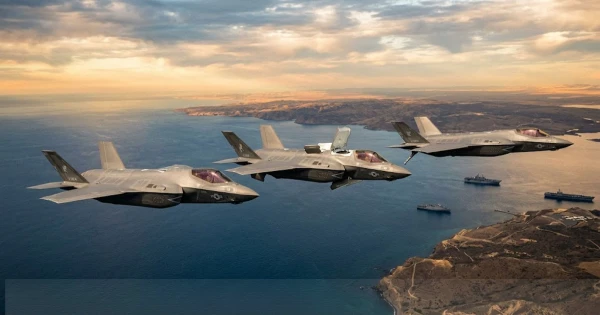
The F-35 Lightning II is no longer just an aircraft program. It's the backbone of American and allied airpower for decades to come, a single jet built in three forms to fly from runways, amphibious ships, and aircraft carriers alike. It's also the most expensive weapons program the Pentagon has ever built, a fact that has made it a fixture of congressional hearings, budget debates, and public arguments about military spending. Understanding how the jet works, why it costs what it costs, and where it fits into U.S. defense strategy matters more than any single news cycle.
This guide breaks down the fundamentals of the F-35 program — its design, capabilities, ongoing modernization, and the debates surrounding it — in plain language meant to hold up no matter what changes in the months ahead.
What the F-35 Lightning II Actually Is
The F-35 Lightning II is a single-seat, single-engine, supersonic stealth fighter built primarily by Lockheed Martin, with major contributions from Northrop Grumman and BAE Systems. It descends from the X-35 demonstrator, which beat Boeing's competing design in 2001 to win the Pentagon's Joint Strike Fighter competition. The goal was to build one airframe family that could replace aging fighters across the Air Force, Navy, and Marine Corps, while also serving as the cornerstone fighter for U.S. allies worldwide.

That ambition produced three variants, each built for a different way of getting into the air:
- F-35A — Conventional takeoff and landing, flown by the U.S. Air Force and most international partners. It's the most numerous variant and the one most people picture when they hear "F-35."
- F-35B — Short-takeoff and vertical-landing, used by the U.S. Marine Corps and allied navies. It can operate from amphibious assault ships and short, austere runways, trading some fuel capacity for that flexibility.
- F-35C — Carrier-based, built for catapult launches and arrested landings aboard U.S. Navy carriers. It has larger wings and a stronger undercarriage, along with the longest range of the three.
All three share the same core mission systems, sensors, and software architecture, even though their airframes differ. That commonality is the program's premise: instead of three separate jets with three separate logistics chains, the military gets a shared ecosystem of parts, training, and maintenance — at least in theory. In practice, achieving that commonality took far longer than planners expected, and the three variants still share fewer parts than originally envisioned.
Why "Fifth-Generation" Matters
The F-35 is routinely described as a "fifth-generation fighter," a term that gets thrown around without much explanation. In practical terms, it refers to four characteristics working together: low observability, or stealth, using shaping and radar-absorbent materials to reduce the aircraft's radar signature; sensor fusion, which combines radar, infrared, and electronic warfare data into a single unified picture instead of separate displays; advanced networking, which lets the jet share targeting data with other aircraft, ships, and ground units in real time; and multirole flexibility, handling air-to-air combat, precision strike, electronic warfare, and reconnaissance in one airframe instead of several specialized aircraft.
The aircraft's sensor suite includes an active electronically scanned array radar, a 360-degree infrared Distributed Aperture System for all-around situational awareness, and an integrated electronic warfare system. Powered by a single Pratt & Whitney F135 engine, the F-35 reaches speeds around Mach 1.6 and operates above 50,000 feet, carrying air-to-air missiles and precision munitions in an internal weapons bay designed to preserve its stealth profile.
How the F-35 Fits Into U.S. and Allied Strategy
The Department of Defense considers the F-35 its largest procurement effort by total cost, with plans to acquire thousands of aircraft for the Air Force, Navy, and Marine Corps over the program's lifetime. Beyond the United States, the jet has become a unifying platform for American allies. Partner nations that helped fund its development, along with additional foreign sales customers, now operate or have ordered F-35s, making it one of the most widely adopted fighters among NATO members and U.S. partners in the Indo-Pacific and Middle East.
That widespread adoption serves a purpose beyond individual squadrons. When allied air forces fly a common platform, they can train together, share spare parts, and integrate more easily in joint operations — an interoperability benefit that persists regardless of which administration is in office or how any single budget cycle shakes out.
Some F-35A aircraft also serve in a dual-capable role, certified to carry both conventional and nuclear weapons under NATO's nuclear-sharing arrangements, underscoring how central the jet has become to broader deterrence strategy.
The Cost Question: Why the F-35 Is So Expensive
No discussion of the F-35 is complete without addressing its price tag, the most persistent point of public criticism. A few structural cost drivers explain the program's economics over the long run:
- Scale and complexity. Developing three variants with shared mission systems required enormous upfront investment before a single jet rolled off the line.
- Concurrent testing and production. The Pentagon manufactured aircraft before testing was complete, a decision later criticized as inefficient, since defects found in testing required retrofitting jets already built.
- Long-term sustainment. Maintaining and operating a fleet over decades makes up the largest share of the program's lifetime cost, which the Government Accountability Office has pegged in the trillions across the aircraft's operational lifespan.
- Continuous modernization. Keeping the jet relevant against evolving threats requires ongoing upgrades, a cost that doesn't disappear once production ends.
Two figures often get conflated: unit cost, what it takes to build one jet, and total program cost, covering research, procurement, and decades of sustainment fleet-wide. Unit cost has trended downward as production matured, while lifetime sustainment cost draws the most scrutiny from auditors and lawmakers.
Modernization: Understanding Block 4 and Why It Matters
A core, enduring feature of the F-35 program is its approach to continuous modernization. Rather than building a fixed aircraft and leaving it unchanged for its operational life, the program is designed around incremental software and hardware upgrades, organized into "Blocks."
The current modernization push, known as Block 4, is intended to expand the jet's weapons compatibility, sharpen its sensors, and strengthen electronic warfare. Block 4 depends on a foundational upgrade called Technology Refresh 3, which boosts onboard computing power and memory so more advanced software can run at all. Without that processing upgrade, many newer capabilities simply lack the headroom to function.
A few principles about the modernization process hold true regardless of timeline. Hardware upgrades typically precede software capability, since new radars and electronic warfare components must be installed before the software that uses them can be fielded. Modernization is phased, not instantaneous, rolling out incrementally across production lots, so different aircraft in the fleet may carry different capability levels at any given time. And engine and power constraints shape what's possible, since more powerful sensors and computing demand more electrical power and cooling, which is why engine upgrades are often bundled into the broader modernization conversation.
This pattern — phased modernization tied to processing power — reflects how modern military aircraft evolve over a multi-decade service life, and it's a dynamic readers can expect to see repeated in future upgrade cycles long after this one concludes.
Common Misconceptions About the F-35
Given how much attention the program receives, a few misunderstandings persist. The F-35 isn't one aircraft — it's a family of three variants with different takeoff and landing methods, built for different services. Stealth doesn't mean invisible; it reduces detectability, but modern sensor networks can still detect low-observable aircraft under certain conditions, especially at close range or specific radar frequencies. Cost overruns don't necessarily mean the program has failed — the aircraft has also been adopted by a large and growing list of allied air forces, generally read as a sign of sustained demand rather than failure. And software updates don't always work perfectly out of the gate; like most complex software-defined systems, F-35 upgrades have experienced stability issues during testing, a normal part of integrating advanced computing into a flying weapons platform.
What to Watch Going Forward
A few recurring themes will keep shaping F-35 coverage for years to come: how Block 4 capabilities roll out and whether future upgrades repeat the same hardware-before-software pattern; allied procurement decisions, which continue to shape production rates and global basing; mission-capable rates and maintenance turnaround times, a recurring focus for congressional oversight; and engine and power upgrades, since long-term capability growth is tied to how the F135 engine program addresses power and cooling demands.
The Bottom Line
The F-35 Lightning II represents a fundamental shift in how the U.S. military and its allies think about airpower — less a single fighter jet and more a networked, continuously upgraded combat system built around stealth, sensor fusion, and shared logistics across services and nations. Its cost and modernization timelines will keep generating headlines, but the underlying structure — three variants, a shared software architecture, and a commitment to incremental upgrades over a multi-decade service life — is the part that will still be true years from now. Track those fundamentals, and the specific numbers in any given budget cycle will make a lot more sense.