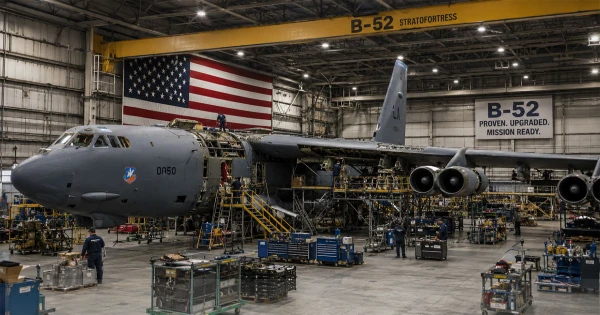
The B-52 Stratofortress first took flight in 1952, back when Harry Truman was president and television was still a novelty in most American homes. More than seven decades later, the same airframe design is undergoing one of the most extensive overhauls in its long history — and the U.S. Air Force expects it to keep flying into the 2050s, eventually approaching its 100th year in service. That is not nostalgia talk from aviation enthusiasts. It is official military planning, backed by tens of billions of dollars in modernization contracts. Understanding why the Pentagon is investing so heavily in B-52 bomber upgrades — rather than retiring the aircraft outright — reveals a great deal about how the U.S. military thinks about cost, capability, and long-term strategic planning.
This article breaks down what is actually changing on the B-52, why the Air Force considers the aircraft irreplaceable for certain missions, and what the upgrade program means for the future of American airpower.
The B-52's Staying Power, Explained
It might seem unusual that an aircraft type older than most of its pilots' grandparents remains central to U.S. long-range strike planning. But the B-52's continued relevance comes down to a few durable advantages that newer aircraft don't necessarily replicate.

Unlike the stealthy B-2 Spirit or the newer B-21 Raider, the B-52 was never designed to sneak past enemy radar. Instead, its airframe offers enormous payload capacity and the structural space to carry oversized munitions, including very large or unconventional weapons that smaller bombers cannot accommodate. That flexibility has made it a preferred platform for both conventional bombing missions and weapons testing programs over the decades.
The bomber also remains one of three legs of the United States' nuclear deterrent, alongside land-based intercontinental ballistic missiles and submarine-launched missiles. That dual-capable role — nuclear and conventional — gives the aircraft strategic importance that goes beyond simple bomb-dropping capacity. Beyond its nuclear mission, the B-52 has flown combat missions continuously since the Vietnam War era, and its ability to loiter for long durations while operating from a small number of bases worldwide has kept it relevant decades after its original design was finalized.
What's Actually Being Upgraded on the B-52
The Air Force's modernization plan for the B-52 fleet is not a single program — it is a collection of separate but interconnected upgrade efforts. Once complete, the modified aircraft will be redesignated the B-52J, marking the first new platform designation for the bomber since the B-52H entered service in the early 1960s.
Replacing the Engines
The centerpiece of the modernization effort is the Commercial Engine Replacement Program, which swaps out the bomber's eight aging Pratt & Whitney TF33 engines — technology dating to the early 1960s — for new Rolls-Royce F130 turbofans. The Air Force has said the original engines will become unsustainable beyond 2030 as spare parts grow increasingly scarce.
The new F130 engine is not an unproven design. It is derived from Rolls-Royce's BR725, a commercial engine that already powers business jets and has logged more than a million flight hours since entering service in the early 2010s. Adapting a proven commercial engine for military use, rather than designing one from scratch, is intended to reduce both technical risk and long-term maintenance costs.
The benefits of the engine swap include:
- Improved fuel efficiency, which extends range and reduces the frequency of aerial refueling
- Greater reliability, since modern commercial engines require less specialized maintenance than the aging TF33s
- Increased electrical power generation to support modern sensors, jamming equipment, and other electronics older engines were never designed to run
- Reduced long-term sustainment costs, as spare parts for 1960s-era engines become harder and more expensive to source
One detail that often gets overlooked is how much modern military capability depends on electrical power generation. Sensors, jamming systems, data links, and defensive electronics all draw on an aircraft's onboard power supply, and the B-52's original engines and generators were designed for a far simpler electronics suite. The new engine pods include modernized generators for each engine, substantially increasing the aircraft's electrical capacity — a change that matters less for current weapons systems and more for whatever sensors and defensive technologies are developed over the coming decades.
Modern Radar and Avionics
Alongside the engine replacement, the B-52 is receiving a new Active Electronically Scanned Array (AESA) radar, designed to enhance the bomber's all-weather navigation and targeting capabilities. AESA technology uses electronically steered beams rather than mechanically rotating dishes, allowing for faster target detection, better jamming resistance, and improved performance in poor weather.
Older B-52s also still relied on analog instrument dials decades after most aircraft transitioned to digital displays. The broader upgrade package addresses that gap with:
- New digital cockpit displays replacing analog dials
- Modernized communications systems
- Updated navigation and mission-system electronics
- New wheels and brakes to support sustained long-term operations
- Structural improvements aimed at extending the aircraft's usable service life
Why Modernize Instead of Replace?
A natural question for readers unfamiliar with military procurement is why the Air Force would spend enormous sums modernizing an aircraft from the 1960s rather than simply building more of its newest bomber, the B-21 Raider. The answer lies in cost, mission diversity, and fleet planning:
- Stealth and payload aircraft serve different roles. The B-21 is designed to penetrate sophisticated modern air defenses using stealth. The B-52 is not stealthy, but it can carry a much larger and more varied weapons load over long distances, making it well-suited for operations where heavy air defenses aren't the primary concern.
- Total fleet capacity matters strategically. Defense analysts have noted that combining a fleet of B-21s with a modernized B-52 fleet would significantly expand the Air Force's overall long-range strike capacity compared to relying on a single bomber type.
- Modernization is generally cheaper than new development. Even with cost overruns, upgrading an existing, well-understood airframe is typically far less expensive than designing, testing, and producing an entirely new bomber fleet.
- The B-52's mission flexibility remains hard to replace, thanks to its capacity for oversized payloads and its long-standing role in weapons testing.
This reflects a recurring pattern in military aviation: extending the service life of a proven, adaptable airframe is often more cost-effective than developing a new one, provided the original design has enough structural flexibility to absorb modern technology.
Common Misconceptions
"It's basically a new airplane built to look old." Not quite. The B-52J upgrade modifies major subsystems — engines, radar, avionics — but the underlying airframe structure remains the original design, reinforced rather than replaced. This is closer to a deep structural renovation than new construction.
"Old aircraft are inherently less safe." Age alone doesn't determine an aircraft's safety; what matters is structural integrity, maintenance history, and whether critical systems remain supportable. The case for the engine replacement centers on parts availability and reliability tied to obsolete technology, not the structural age of the airframe itself.
"Modernizing is just a stopgap until retirement." This misreads the timeline. The Air Force's stated plan is for the B-52J to remain part of the long-range strike fleet for multiple more decades, operating alongside the B-21 rather than being phased out by it.
Lessons From a Long-Running Modernization Effort
Programs of this scale — touching engines, radar, electronics, and structural elements simultaneously — rarely proceed without complications. Engineering challenges, cost growth, and schedule adjustments are common features of major weapons-system modernization, and the B-52 program has experienced its share of both. A few patterns tend to hold true across efforts like this:
- Complex multi-system upgrades almost always take longer than initial estimates suggest
- Cost growth is common when integrating modern subsystems into older airframes
- Testing phases, rather than design phases, often reveal the most significant technical challenges
- Programs that adapt proven commercial technology, rather than developing entirely new systems, tend to carry lower long-term risk
These patterns aren't unique to the B-52; they reflect how large-scale military modernization generally works, regardless of the aircraft or system involved.
Key Takeaways
The B-52 bomber upgrade program is one of the more ambitious aircraft modernization efforts in U.S. military history — not because the airframe itself is changing dramatically, but because nearly every system inside it is being replaced or rebuilt. Modern engines, advanced radar, updated electronics, and structural improvements are designed to keep the aircraft operationally relevant for missions that newer, stealth-focused bombers were never intended to perform.
For readers trying to make sense of why a decades-old aircraft remains central to American airpower, the explanation isn't sentimentality. It comes down to payload flexibility, dual-role capability in the nuclear triad, and a cost-effectiveness case that favors deep modernization over wholesale replacement. As the modernized B-52J variant moves through testing in the years ahead, it will continue flying alongside the newer B-21 Raider — a reminder that stealth capability and payload capacity remain two distinct, and equally necessary, pillars of American long-range strike strategy.