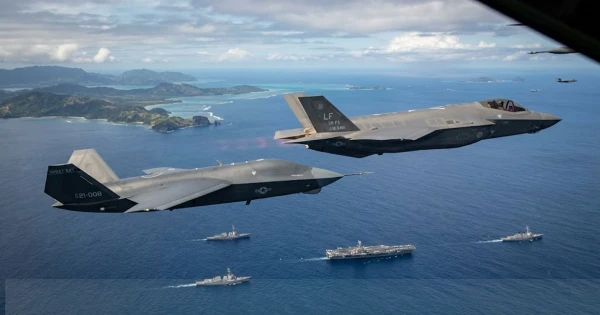
The U.S. Air Force’s new MQ-28 Ghost Bat — a loyal wingman drone designed to fly alongside manned fighters — has made its first operational appearance in a Pacific exercise, marking a milestone in how the U.S. and its allies train for integrated air combat. The deployment underscores a broader shift toward collaborative combat aircraft (CCA), systems that extend pilot reach, share sensor data, and take on risky tasks without putting crewed jets directly in harm’s way. For military planners, aviators, and defense observers, the Ghost Bat’s Pacific debut offers a practical look at how drones and humans will operate together in contested skies for years to come.
Why this matters: collaborative combat aircraft like the MQ-28 change force structure, tactics, and logistics while raising questions about interoperability, rules of engagement, and long-term sustainment. The Ghost Bat’s early operational use provides a clearer view of the advantages and challenges of integrating autonomous and semi-autonomous systems into allied air operations — a development with lasting implications for U.S. defense posture in the Indo-Pacific and beyond.
MQ-28 Ghost Bat: What it is and what it does
F-22 Raptor Modernization: How the U.S. Air Force Is Extending the Life of Its Stealth Fighter

-
Purpose: The MQ-28 Ghost Bat is a “loyal wingman” unmanned combat aerial vehicle (UCAV) designed to accompany crewed aircraft and perform roles including intelligence, surveillance, electronic warfare, decoying, and kinetic strike when needed.
-
Design features: Built with a focus on affordability, open-systems architecture, and modular payloads, the Ghost Bat prioritizes sensor integration and secure communications to work alongside legacy fighters such as the F-35 and F-22.
-
Autonomy level: The MQ-28 operates with varying levels of autonomy — from remotely piloted to cooperative, mission-authority modes where onboard systems execute tasks under human oversight.
-
Alliance operations: Its debut in a multinational Pacific exercise highlights NATO-style interoperability for Indo-Pacific partners, emphasizing common data links, shared tactics, and coalition command-and-control interfaces.
How the deployment fits long-term defense trends
The appearance of the MQ-28 in Pacific training reflects several durable, strategic trends:
-
Human-machine teaming: Militaries are increasingly pairing humans with machines to multiply effects and reduce risk. CCAs augment pilot decision-making and improve situational awareness while allowing manned platforms to focus on higher-level mission tasks.
-
Distributed operations: Drone wingmen support dispersed force concepts by conducting long-duration missions, acting as forward sensors, or presenting additional weapons options without the vulnerabilities of a single, high-value manned aircraft.
-
Cost and attritability: Lower unit cost and modularity make CCAs more expendable in high-threat environments compared with fifth-generation fighters, enabling risk-tolerant employment where human life and expensive assets are at stake.
-
Open architecture and upgrades: Designing CCAs with open, modular software and hardware ensures rapid fielding of new sensors, weapons, or algorithms — a necessity given the pace of electronic warfare and sensor development.
Operational advantages demonstrated in exercise settings
-
Sensor fusion: Ghost Bat platforms can aggregate sensor data from multiple sources and pass synthesized feeds to manned jets, increasing the battlespace picture without overloading pilots.
-
Force multiplication: A single crewed aircraft paired with several CCAs can emulate a larger formation, complicating an adversary’s targeting and decision cycles.
-
Risk management: CCAs can perform high-risk tasks such as suppression of enemy air defenses (SEAD), decoy sorties, or deep reconnaissance, reducing exposure for pilots and expensive aircraft.
-
Flexible payloading: Modular bays allow quick reconfiguration between roles — for example, switching from electronic warfare packages to additional fuel tanks or weapon stores.
Technical and operational challenges to address
-
Communications and datalink security: CCAs rely on robust, encrypted links for command, control, and data. Jamming, spoofing, and cyberattacks remain persistent risks that must be mitigated through resilient architectures and alternative routing.
-
Rules of engagement and human control: Determining how much autonomy CCAs can exercise — especially for lethal actions — remains a legal, ethical, and doctrinal challenge. Clear policy and fail-safe mechanisms are essential to maintain human accountability.
-
Interoperability with allies: Seamless coalition operations require standardized protocols, shared data formats, and trust frameworks so U.S. and partner CCAs can exchange information and receive coalition tasking securely.
-
Logistics and sustainment: Fielding new airframes creates sustainment demands for spare parts, trained maintainers, and supply chains — particularly across dispersed bases in the Pacific.
-
Training and tactics development: Pilots and mission planners must learn new tactics for human-machine teams, including how to delegate tasks, manage autonomy, and exploit CCAs’ unique capabilities without creating cognitive overload.
Practical recommendations for integrating CCAs into long-term force posture
-
Invest in resilient communications: Prioritize mesh, multi-path datalinks and anti-jam measures. Redundant satellite, line-of-sight, and airborne relay layers reduce single-point failures.
-
Define clear human-in-the-loop policy: Codify rules for human oversight, especially for lethal engagements. Incorporate robust “abort” and fail-safe options in all operational modes.
-
Standardize coalition interfaces: Promote common standards for datalinks, mission data formats, and authentication to ease multinational operations and increase trust among allies.
-
Expand tactical training: Create curricula for pilots, sensor operators, and commanders focused on human-machine teaming, mission delegation, and joint tactics, techniques, and procedures (TTPs).
-
Plan logistics for austere environments: Pre-position spare parts and specialized tools in key regions, and cross-train maintenance personnel for rapid turnaround in forward locations.
Common misconceptions, explained
-
Misconception: CCAs will replace manned fighters soon.
Reality: CCAs are designed to complement, not replace, crewed aircraft. High-end air superiority still relies on human pilots aboard advanced platforms for complex mission decisions and sovereign deterrence. -
Misconception: CCAs operate fully autonomously without human involvement.
Reality: Contemporary CCAs typically operate under supervised autonomy with human oversight for critical decisions, especially those involving use of lethal force. -
Misconception: CCAs are only for strike missions.
Reality: CCAs serve diverse roles including sensing, electronic warfare, decoying, communications relay, and logistics — often more valuable for their information contribution than pure firepower.
Implications for the Indo-Pacific and allied defense cooperation
The MQ-28’s Pacific exercise role signals how the U.S. intends to strengthen deterrence and resilience across a vast theater. In practice:
-
Alliances gain a force-multiplier: Partner air forces that can operate CCAs alongside U.S. platforms increase collective coverage, complicate adversary targeting, and improve combined response options.
-
Theater posture adapts to geography: The long ranges and distributed basing patterns in the Indo-Pacific make CCAs particularly useful for persistent surveillance, dispersed command architecture, and austere logistics.
-
Procurement and export strategies matter: Collaborative development and export controls will shape partner access to CCAs, affecting regional balance and interoperability for years to come.
How policymakers and citizens can evaluate progress
-
Look for transparent doctrine: Publicly available doctrine and legal frameworks about autonomy, engagement authority, and oversight signal responsible development.
-
Assess investment in resilience: Funding for secure communications, training, and sustainment is as important as the number of airframes procured.
-
Monitor interoperability efforts: Progress on coalition exercises, shared standards, and combined training programs indicates real operational integration rather than isolated demonstrations.
Conclusion
The MQ-28 Ghost Bat’s debut in a Pacific exercise is a practical demonstration of how collaborative combat aircraft are becoming a durable element of modern airpower. By extending sensors, dispersing risk, and multiplying effects, CCAs offer a scalable way to enhance deterrence and operational flexibility in contested regions. That promise comes with technical, legal, and logistical challenges that require sustained investment in resilient communications, clear human oversight, allied standardization, and revised training and sustainment plans. For defense planners and the public alike, the Ghost Bat’s early use is less about a single platform and more about a long-term shift in how air forces will organize, fight, and cooperate in the decades ahead.