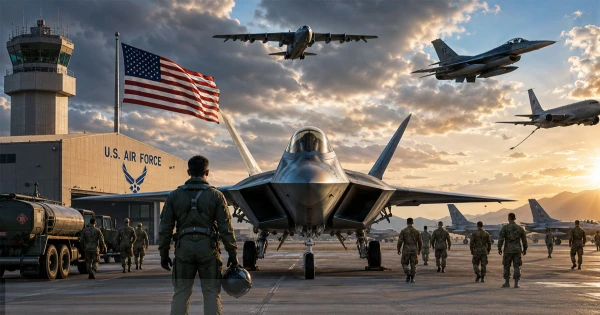
When most Americans think about national security, images of soldiers on the ground or ships at sea often come to mind first. Yet for more than 75 years, the United States Air Force has quietly formed the backbone of America's ability to project power, deter conflict, and respond to crises anywhere on the planet within hours. Understanding how this branch operates, trains, and evolves isn't just a matter of military curiosity—it's essential context for anyone trying to grasp how the United States maintains global stability in an increasingly complex world.
This article breaks down the structure, mission, and enduring relevance of the U.S. Air Force, offering a clear, fact-based look at one of the most technologically advanced and strategically vital institutions in the country.
What the U.S. Air Force Actually Does
The Air Force's core mission is deceptively simple to state but enormously complex to execute: fly, fight, and win in air, space, and cyberspace. Established as an independent service in 1947, it grew out of the Army Air Forces and has since developed into a force responsible for far more than combat aviation.

Core Mission Areas
The Air Force organizes its responsibilities around several enduring functions:
- Air superiority — ensuring U.S. and allied aircraft can operate without interference from adversary forces
- Global strike — the ability to deliver precision airpower anywhere in the world
- Rapid global mobility — transporting troops, equipment, and humanitarian aid across continents
- Intelligence, surveillance, and reconnaissance (ISR) — gathering and analyzing data critical to decision-making
- Space operations — managing satellite communications, GPS, and missile warning systems
- Cyberspace operations — defending military networks and critical infrastructure from digital threats
These mission areas haven't changed dramatically in decades, even as the technology supporting them has advanced significantly. That consistency is part of why understanding the Air Force's structure remains valuable knowledge for years to come.
Organizational Structure: How the Air Force Is Built
The Air Force operates under the Department of the Air Force, one of three military departments within the Department of Defense, alongside the Army and Navy. Since 2019, it has also overseen the U.S. Space Force, which was established as a separate branch but remains administratively connected to the Air Force.
Major Commands
The Air Force divides its operational responsibilities among major commands, each focused on a distinct function:
- Air Combat Command (ACC) — oversees fighter, bomber, and reconnaissance operations
- Air Mobility Command (AMC) — manages cargo and refueling aircraft for global logistics
- Air Force Global Strike Command — controls long-range bombers and the land-based nuclear missile force
- Air Force Materiel Command — handles research, acquisition, and sustainment of equipment
- Air Education and Training Command — responsible for recruiting, training, and educating airmen
This structure allows the service to maintain specialized expertise while coordinating seamlessly during joint operations with other military branches.
Active Duty, Guard, and Reserve
A point often misunderstood by the public is that the Air Force isn't a single monolithic force. It operates through three components:
- Regular Air Force — full-time active-duty personnel
- Air National Guard — state-based forces that can be activated for federal or state missions
- Air Force Reserve — part-time personnel who can be called to active duty when needed
This tri-component system provides flexibility, allowing the nation to scale its airpower up or down based on need without maintaining an unsustainably large standing force.
Careers and Pathways: How People Join the Air Force
For readers considering military service, the Air Force offers several distinct entry points depending on background, education, and career goals.
Enlisted vs. Officer Tracks
- Enlisted airmen typically enter after completing Basic Military Training and then attend technical training for a specific job specialty, ranging from aircraft maintenance to cybersecurity.
- Officers generally enter through one of three paths: the U.S. Air Force Academy, Air Force Reserve Officer Training Corps (AFROTC) at civilian universities, or Officer Training School for college graduates.
In-Demand Career Fields
While the Air Force operates fighter jets and bombers most visibly, the majority of its workforce supports operations in less publicized but equally critical roles:
- Aircraft and avionics maintenance
- Cybersecurity and information technology
- Intelligence analysis
- Logistics and supply chain management
- Medical and healthcare services
- Air traffic control
- Space systems operations
This diversity of roles means the Air Force functions less like a single fighting unit and more like a highly specialized organization comparable in complexity to a major corporation or government agency.
Training and Readiness: The Foundation of Air Power
No discussion of the Air Force is complete without addressing how it prepares personnel for high-stakes environments. Training is continuous, not a one-time event.
Basic Training and Beyond
Enlisted recruits complete Basic Military Training, an intensive program focused on discipline, physical fitness, and foundational military skills. From there, airmen move into Technical Training, where they learn the specific skills required for their assigned career field.
Officers undergo separate, more leadership-focused training designed to prepare them for decision-making roles, often including specialized flight training for those pursuing aviation careers.
Ongoing Professional Development
Unlike many civilian careers, Air Force training doesn't stop after initial qualification. Airmen progress through:
- Professional military education tied to rank advancement
- Recurrent technical certifications
- Leadership development courses
- Specialized mission training, such as combat search and rescue or special operations support
This emphasis on lifelong learning reflects a broader truth about modern military service: technology and tactics evolve constantly, and personnel must evolve alongside them.
Technology and Innovation in the Air Force
The Air Force has historically served as a proving ground for technologies that later influence civilian life, from GPS navigation to advances in jet propulsion and materials science.
Aircraft Categories
Air Force aircraft generally fall into several functional categories:
- Fighters — designed for air-to-air combat and tactical strike missions
- Bombers — built for long-range, heavy payload missions
- Transport and tanker aircraft — essential for moving personnel, cargo, and fuel
- Reconnaissance and surveillance aircraft — used for intelligence gathering
- Remotely piloted aircraft — increasingly important for ISR and precision missions without placing pilots directly in harm's way
The Growing Role of Space and Cyber
Modern airpower extends well beyond the atmosphere. Satellite systems managed in coordination with the Space Force support everything from weather forecasting to secure military communications. Meanwhile, cyber defense has become a permanent fixture of national security strategy, with dedicated units protecting critical infrastructure and military networks from persistent digital threats.
This expansion illustrates an important, lasting trend: the definition of "air power" has broadened to include domains that didn't exist when the Air Force was founded.
Common Misconceptions About the Air Force
Several misunderstandings persist about how the Air Force operates, and clearing them up helps readers better understand the institution.
Misconception 1: Most airmen are pilots.
In reality, pilots represent a small fraction of total personnel. The vast majority work in maintenance, logistics, intelligence, medical, and technical support roles that keep aircraft and missions functioning.
Misconception 2: The Air Force only handles combat operations.
Humanitarian airlift, disaster relief logistics, and global mobility missions make up a substantial portion of Air Force activity, particularly during natural disasters or international crises.
Misconception 3: Space Force replaced the Air Force's space mission entirely.
While Space Force now leads dedicated space operations, the two services remain closely integrated, and the Department of the Air Force continues to oversee both.
Why the Air Force's Role Matters Long-Term
Beyond combat readiness, the Air Force plays a quieter but equally important role in national infrastructure. GPS technology, used daily by civilians for navigation, banking transactions, and logistics, is maintained through Air Force-managed satellite systems. Air Mobility Command routinely supports disaster response efforts domestically and internationally, delivering supplies during hurricanes, earthquakes, and humanitarian crises.
This dual-purpose function, serving both military deterrence and civilian-supporting infrastructure, is one of the most enduring aspects of the institution and unlikely to change in the foreseeable future.
Final Takeaways
The U.S. Air Force represents far more than fighter jets and dramatic flyovers. It is a complex, multi-domain organization responsible for air superiority, space operations, cyber defense, and global logistics, supported by hundreds of thousands of personnel working across enlisted, officer, Guard, and Reserve components.
For readers interested in military careers, national security policy, or simply understanding how modern defense systems function, a few practical points stand out:
- The Air Force offers diverse career paths beyond piloting, with technical and support roles forming the majority of its workforce.
- Training is continuous throughout a service member's career, not limited to initial entry.
- The scope of "airpower" now includes space and cyberspace, reflecting how national defense has evolved.
- Civilian infrastructure, particularly GPS and disaster response logistics, depends significantly on Air Force capabilities.
Whether viewed through the lens of national defense, career opportunity, or technological innovation, the U.S. Air Force remains a foundational institution whose structure and mission are built for long-term relevance rather than short-term headlines.