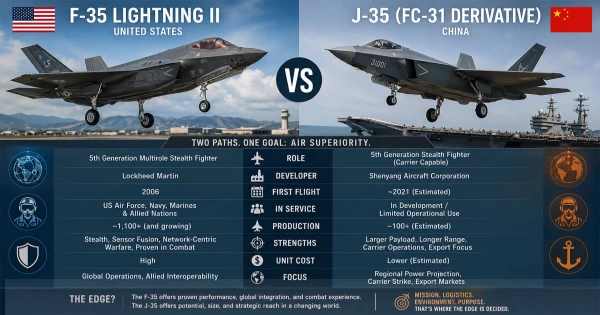
The U.S. F‑35 Lightning II and China’s emerging J‑35 (FC‑31 derivative) represent two different paths to fifth‑generation capability — one mature, widely fielded and integrated into allied networks; the other newer, larger and tailored for carrier operations and export ambitions — and choosing “the edge” depends on mission, logistics and combat environment rather than a single statistic.
Why this matters
-
Modern air power depends as much on sensors, data links and sustainment as on top speed or a low radar cross-section; readers trying to understand whether the J‑35 threatens U.S. air superiority need to look past headlines to systems, doctrine and logistics.

Design and mission roles
-
F‑35: A single‑engine stealth multirole fighter offered in three purpose-built variants (A, B, C) for conventional, short‑takeoff/vertical‑landing and carrier operations, emphasizing stealth, sensor fusion and multirole flexibility.
-
J‑35: A twin‑engine platform developed from China’s FC‑31 programs, reportedly optimized with carrier-capable features and export potential; it’s larger and oriented toward maritime and carrier operations in some variants.
Stealth and signatures
-
F‑35 strengths: Proven low observable shaping, extensive radar‑absorbent materials and integrated signature management that result in a very small estimated radar cross‑section and operational stealth in many scenarios.
-
J‑35 strengths and limits: The J‑35 adopts stealth shaping and internal bays, but open assessments suggest a larger physical size and higher radar signature than the F‑35, meaning it may be less stealthy in long‑range engagements.
Sensors, avionics and information advantage
-
F‑35 advantage: The F‑35’s advanced AESA radar, sensor fusion and mature electronic warfare and datalink suites create a single integrated battlespace picture for the pilot and networked forces — an operational edge in situational awareness.
-
J‑35 trajectory: Reports indicate modern AESA radar and improving EW suites, but analysts generally assess Chinese sensor fusion and datalinks as less mature and less fielded at scale compared with the F‑35’s combat‑proven systems.
Performance: speed, range and maneuverability
-
Speed and thrust: Open reporting estimates the F‑35’s top speed near Mach 1.6 powered by the Pratt & Whitney F135 engine, while some J‑35 projections suggest higher top speed potential (Mach ~1.8) using newer Chinese engines. Speed alone doesn’t determine combat outcomes.
-
Range and payload: The J‑35 is reported to have a larger airframe and potentially greater ferry range in some configurations, while the F‑35’s internal fuel and mission‑effective combat radius are optimized for integrated strike and fighter missions.
-
Maneuverability: The F‑35 relies on fly‑by‑wire and stealth‑optimized aerodynamics; Chinese sources suggest the J‑35 may emphasize higher instantaneous maneuverability and possibly thrust vectoring, though independent verification remains limited.
Weapons and internal payload
-
F‑35 armament: Internal weapons bays support air‑to‑air missiles and precision-guided munitions while preserving stealth; a broad catalog of allied munitions is integrated and continually updated.
-
J‑35 armament: The J‑35 is reported to carry Chinese PL‑10/PL‑15 air‑to‑air missiles and Chinese guided munitions internally, with external mounting options that increase payload but compromise stealth. Both fighters trade stealth for larger loads when needed.
Operational maturity and sustainment
-
F‑35 service record: More than a decade of operational deployments, multinational logistics networks, training pipelines and incremental software/hardware upgrades give the F‑35 an advantage in reliability, maintenance practices and combat‑proven tactics.
-
J‑35 fielding: The J‑35 is comparatively new, with limited operational history and fewer deployed squadrons, meaning China faces a learning curve in fleet sustainment, carrier integration and widespread pilot training.
Force structure and doctrine implications
-
Integrated networks: The F‑35 is embedded within NATO and allied command-and-control ecosystems, multiplying its value through shared sensors and cooperative engagement. That network effect is often decisive.
-
Chinese doctrine: The J‑35 is tailored to China’s maritime environment and carrier ambitions, fitting into Chinese anti‑access/area denial (A2/AD) doctrine and regional power projection strategies rather than mirroring U.S. expeditionary concepts.
Common misconceptions
-
“Faster is better”: Higher top speed does not automatically win engagements; detectability, beyond‑visual‑range missiles and integrated sensors often decide outcomes.
-
“One jet equals air superiority”: Air superiority depends on training, numbers, logistics, maintenance and coalition interoperability as much as hardware.
What gives an operational edge
-
Systems integration: Proven sensor fusion, secure datalinks and effective EW capability create situational awareness advantages that translate to survivability and lethality.
-
Logistics and scale: A mature global sustainment network and large operational fleet sustain continuous operations — an advantage the F‑35 currently holds.
-
Platform fit to mission: The J‑35 may hold tactical advantages in specific maritime or carrier contexts, but the F‑35’s proven integration into allied forces gives it broader strategic utility.
Practical takeaways for readers
-
For allied planners and policymakers: Assess capability in context — fielded systems, training and interoperability matter more than headline top speeds or shape comparisons.
-
For aviation enthusiasts: Expect continued incremental improvements to both platforms — avionics, engines and weapons change the balance more than airframe silhouette alone.
-
For analysts: Compare not just airframes but networks, doctrine and sustainment to judge long‑term advantage.
Conclusion: Which fighter has the edge?
-
There’s no single winner; the F‑35 currently holds an operational and networking edge due to proven sensor fusion, global logistics and allied integration, while the J‑35 offers promising range, payload and maritime design that could be highly effective within China’s strategic context. The decisive factor in future encounters will be networks, training and sustainment — not just one jet’s top speed or shape.