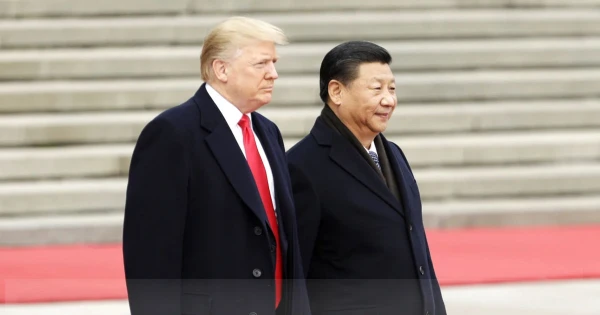
In May 2026, President Donald Trump traveled to Beijing for a landmark summit with Chinese President Xi Jinping. This marked the first visit by a sitting U.S. president to China in nearly a decade. The two leaders committed to building a constructive relationship of strategic stability, aiming to manage deep-seated competition while preventing escalation into broader conflict.
The meeting came amid persistent tensions over trade, technology, and regional security. Yet both sides signaled a shared interest in stability. They emphasized fairness, reciprocity, and controlled competition as guiding principles for bilateral ties.
This framework echoes elements of Cold War-era strategic thinking. During that period, the United States and the Soviet Union maintained a tense balance rooted in the concept of mutual assured destruction. Nuclear capabilities deterred direct confrontation despite profound ideological differences.

Today, the U.S.-China dynamic features a parallel but distinct form of interdependence. Economic ties bind the world's two largest economies in ways that raise the costs of unchecked rivalry. Supply chains, financial markets, and consumer goods flows create mutual vulnerabilities that neither side can easily ignore.
Globalization has woven American and Chinese economies together more tightly than ever. Companies on both sides rely on components, markets, and investment from the other. Disruptions in one area ripple across industries, affecting jobs, prices, and innovation worldwide.
The summit produced tangible outcomes in trade. China agreed to significant purchases of U.S. agricultural products, providing relief to American farmers. Discussions also addressed market access, investment frameworks, and efforts to curb fentanyl precursors flowing into the United States.
New bilateral institutions, including boards focused on trade and investment, aim to foster ongoing dialogue. These mechanisms seek to resolve disputes more predictably and promote reciprocity in economic dealings.
Taiwan remains one of the most sensitive flashpoints. Chinese leaders stressed its centrality to bilateral relations, warning that mishandling the issue could jeopardize overall stability. The U.S. side has consistently affirmed its commitments under existing policy frameworks while navigating complex regional dynamics.
Broader regional security concerns, including North Korea's denuclearization and developments in the Middle East, also featured in talks. Both nations recognize the need for coordination on global challenges that transcend bilateral competition.
Economic interdependence does not eliminate risks. The Russia-Ukraine conflict illustrated how energy ties failed to prevent war when political divergences proved too deep. That relationship was narrower and more asymmetric than current U.S.-China economic links.
In contrast, U.S.-China ties span manufacturing, technology, finance, and consumer markets. This breadth creates stronger incentives for restraint. Full decoupling would inflict severe self-harm on both economies, disrupting everything from electronics production to agricultural exports.
Recent years have seen efforts to reduce vulnerabilities through diversification. Many nations, including the United States, have pursued strategies often described as "de-risking" rather than full separation. Supply chains have shifted toward Southeast Asia and other partners, while maintaining essential connections with China.
These measures aim to enhance resilience without triggering the very fragmentation they seek to avoid. Overly aggressive decoupling risks dividing the global economy into rival blocs, raising costs for businesses and consumers everywhere.
Technological competition adds another layer of complexity. Advances in artificial intelligence, semiconductors, and quantum computing carry both economic and security implications. Export controls and investment reviews reflect efforts to protect critical capabilities while competition drives innovation forward.
The summit highlighted ongoing differences in how each side defines stability. American priorities focus on fair trade, intellectual property protection, and national security safeguards. Chinese perspectives emphasize respect for core interests and mutual recognition of development paths.
Despite these gaps, the agreement on strategic stability provides a conceptual foundation for managing disputes. It envisions competition within bounds, with open communication channels to prevent miscalculation.
Global supply chains for critical minerals, including rare earths, illustrate the stakes. Both nations have leverage in these areas, but weaponizing them could backfire by accelerating diversification and raising prices across industries.
The U.S. economy benefits from access to Chinese manufacturing scale and markets. China relies on American technology, investment, and consumer demand to sustain growth. This symmetry underpins the logic of managed coexistence.
Public and business sentiment in both countries reflects fatigue with prolonged uncertainty. American companies seek clearer rules for operating in China, while Chinese firms look for predictability in accessing U.S. markets.
The summit also touched on people-to-people ties. Cultural and educational exchanges have historically helped humanize relations even during tense periods. Sustaining these connections remains important for long-term understanding.
Looking ahead, both leaders expressed hopes for future visits. President Trump invited President Xi to Washington later in 2026. Such reciprocal engagement could help institutionalize the stability framework.
International observers watch closely as the relationship evolves. Many nations benefit from stable U.S.-China ties that support global growth and address transnational issues like climate change and public health.
A fragmented world order would complicate cooperation on these fronts. Conversely, managed competition allows space for innovation and progress while reducing the risk of catastrophic confrontation.
The concept of harmony without uniformity, drawn from traditional Chinese philosophy, resonates with the current approach. Differences persist, but they need not escalate into outright hostility.
In practice, this means maintaining dialogue on contentious issues, establishing guardrails for military activities, and finding areas where cooperation serves mutual interests.
Trade volumes between the two countries remain substantial despite tariffs and restrictions. Bilateral goods trade has shown resilience, underscoring the deep integration that policymakers must navigate.
Agricultural agreements provide concrete benefits to U.S. producers. Increased Chinese purchases of soybeans, corn, and other commodities support rural economies and help balance trade flows.
On the technology front, both sides continue selective restrictions. The United States maintains controls on advanced semiconductors and related equipment. China advances domestic capabilities while engaging in global markets.
Financial linkages also matter. Capital flows, stock listings, and investment vehicles connect markets in New York and Shanghai. Disruptions here could affect retirement savings and corporate financing worldwide.
Energy security adds another dimension. Global markets for oil, liquefied natural gas, and renewables respond to developments in U.S.-China relations, especially amid other geopolitical tensions.
The May summit occurred against the backdrop of the U.S. 250th anniversary celebrations. This timing lent symbolic weight to discussions about the future of great-power relations in the 21st century.
Analysts note that the framework does not resolve underlying strategic competition. It instead seeks to channel that competition into more predictable and less dangerous forms.
Implementation will test the durability of the agreement. Regular high-level meetings, working groups, and crisis communication mechanisms will prove essential.
For American businesses, clearer signals on tariffs and market access could encourage investment planning. Many firms have already diversified operations but continue to value engagement with the Chinese market.
Consumers on both sides stand to gain from stable relations. Lower uncertainty supports affordable goods, steady employment, and broader economic opportunities.
Challenges remain in areas like intellectual property, subsidies, and state-directed industrial policies. Addressing these through negotiation rather than escalation aligns with the stability goal.
Regional allies and partners in Asia, Europe, and beyond seek reassurance that U.S.-China management will not come at their expense. Balancing bilateral progress with multilateral commitments is key.
Environmental cooperation offers potential common ground. Both nations are major players in renewable energy, electric vehicles, and emissions reduction. Joint efforts could accelerate global progress.
Public health preparedness represents another area for collaboration. Lessons from past pandemics underscore the value of information sharing and coordinated responses.
As the relationship matures under this new framework, success will depend on consistent implementation and adaptability to changing circumstances.
The Trump-Xi summit represents a pragmatic step toward coexistence amid rivalry. It acknowledges that the two powers must find ways to compete without undermining the global system that benefits both.
This approach does not eliminate friction but seeks to contain it within manageable limits. In an interconnected world, such restraint serves the interests of Americans, Chinese citizens, and people everywhere.
The coming months and years will reveal how effectively this vision translates into sustained stability. For now, the commitment to constructive strategic stability offers a foundation for navigating one of the most consequential relationships of our time.