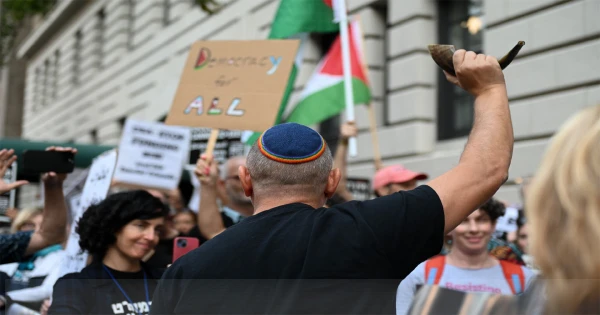
A profound shift is reshaping perspectives within the American Jewish community, particularly among younger generations. Traditional assumptions about unified support for Israeli policies are giving way to deeper questions about identity, ethics, and the use of Jewish safety as justification for military actions. The ongoing situation in Gaza has not only divided opinions but also fractured what was once seen as a foundational consensus on unconditional backing for Israel.
Recent surveys highlight the extent of this change. A significant majority of American Jews now express concern over Israel's conduct in Gaza, with many viewing specific actions as violations of international norms. Approximately six in ten believe war crimes have occurred, while nearly four in ten describe the events as amounting to genocide. These figures underscore a growing moral reckoning that transcends simple policy disagreements.
Support for Israel's military operations has declined sharply in certain segments. Joint academic studies from institutions like the University of California, Berkeley, indicate that only about three in ten American Jews back the current approach, with opposition reaching nearly six in ten overall. The generational divide stands out clearly. Emotional attachment to Israel remains relatively strong among those over 65, but it drops dramatically among adults aged 18 to 34, falling to roughly half or lower in some measures.

Half of younger American Jews now characterize the Gaza events as genocide. This perspective reflects not a rejection of Jewish identity but a crisis of conscience driven by vivid images of civilian suffering, widespread destruction, and humanitarian challenges. Social media has amplified these realities, exposing younger people to unfiltered accounts that differ from earlier generations' experiences.
Political affiliation further accentuates the split. Overwhelming majorities of Jewish Republicans continue to support Israel's actions, while Democratic identification correlates with much lower approval rates, creating gaps of 50 percentage points or more. Broader American sympathy for Israel has also eroded. For the first time in decades of tracking, it has dipped below even levels, influenced heavily by declining support among Democrats and independents.
This evolution has weakened traditional bipartisan consensus on U.S. policy toward Israel. Organizations like the American Israel Public Affairs Committee face new pressures as unified backing frays across party lines. The changes signal a community in transition, where loyalty to Jewish values of justice increasingly informs critiques of state actions.
Jewish Voice for Peace, a longstanding group advocating for Palestinian rights and against occupation, has experienced remarkable expansion. Founded in the mid-1990s with a handful of students in Berkeley, it now boasts tens of thousands of dues-paying members and a supporter network exceeding hundreds of thousands. Annual revenue has tripled in recent years, reaching double-digit millions, enabling larger conferences, advocacy campaigns, and grassroots mobilization.
The organization's growth reflects broader discontent. Its conferences have drawn prominent progressive voices and focused on themes of ethical responsibility, encapsulated in the idea that actions should not be carried out "in our name." Efforts emphasize separating Jewish religious and cultural identity from political Zionism, promoting instead universal principles of equality and human rights.
In 2025, the group took a notable step by enhancing its electoral engagement. Members voted to restructure for greater political impact, including candidate endorsements, lobbying in Congress, and leveraging membership strength in primaries and local races. This pivot underscores a belief that criticism of Israeli policies no longer disqualifies participants in Democratic politics.
New York City exemplifies these dynamics. The Jewish population there mirrors national trends of diversification in viewpoints. Residents describe a landscape featuring pro-Israel voices, pro-Palestinian Jewish activists, and those with minimal connection to Israeli affairs. This pluralism marks a departure from past uniformity.
Polling among younger non-Orthodox Jews reveals striking openness to alternatives. Roughly half under age 35 now favor a binational state solution, a position nearly unthinkable in mainstream circles a decade earlier. Support for one-state frameworks with equal rights has roughly doubled in recent years, reaching the low-to-mid 20s percent nationally.
The 2025 New York City mayoral election highlighted this momentum. Zohran Mamdani, a 34-year-old democratic socialist and son of Ugandan immigrants, secured a decisive victory. His campaign openly criticized Israeli operations in Gaza and supported boycott initiatives. Progressive Jewish organizations provided key backing, contributing to his strong performance among diverse voter coalitions.
U.S. military assistance to Israel has remained substantial throughout the period. Annual baseline support hovers around $3.8 billion under long-term agreements, with supplemental funding pushing totals significantly higher since late 2023. Combined military aid, including munitions, missile defense, and related systems, has exceeded $20 billion in the two years following October 2023. These resources constitute a notable portion of Israel's defense spending.
Critics argue that unconditional aid diminishes U.S. leverage and entangles America deeper in regional conflicts. Proponents maintain it bolsters a key ally against shared threats. The debate intersects with domestic discussions about foreign policy priorities, budget allocation, and moral consistency in international affairs.
Prominent Jewish American figures have joined the chorus of concern. Senator Bernie Sanders publicly stated that evidence compelled him to describe certain actions as meeting the definition of genocide, marking a notable stance for a sitting lawmaker. Such positions reflect internal community deliberation rather than external imposition.
Leaders of more centrist groups acknowledge the drift. Some attribute younger disengagement to successive right-leaning Israeli governments and perceived demands for unquestioning loyalty. Exposure to social media footage of hardship in Gaza has shaped worldviews formed without the same historical context of earlier generations.
The transformation carries cultural and religious dimensions. Many young Jews draw on Jewish traditions emphasizing tikkun olam—repairing the world—and opposition to injustice. Protests and advocacy invoke these ethical imperatives, framing dissent as an expression of authentic Jewish values rather than disloyalty.
Community relations have felt the strain. Family discussions about Israel sometimes lead to tension, and public expressions of differing views carry risks of social ostracism within tight-knit circles. Yet surveys suggest many American Jews distinguish between the Israeli government and the broader population or state itself.
Broader U.S. public opinion has followed similar patterns. Approval for Israel's military campaign in Gaza has reached historic lows, with disapproval climbing above 60 percent in some measurements. Favorability toward the Israeli government has declined, even as views of Israeli people remain somewhat warmer.
This environment challenges established advocacy models. Traditional institutions face pressure to adapt messaging for younger audiences who prioritize human rights universality alongside Jewish security. Efforts to foster dialogue across divides have increased, though consensus remains elusive.
The shift among young American Jews appears durable. Raised amid evolving global narratives, digital connectivity, and domestic movements for racial and economic justice, they approach the Israeli-Palestinian issue through lenses of equality and accountability. Many reject binary choices, seeking paths that honor both Jewish self-determination and Palestinian rights.
Long-term implications for U.S. foreign policy remain uncertain. Sustained activism could influence congressional positions, campaign platforms, and public discourse. If generational trends continue, future policymakers may encounter a more pluralistic Jewish American voice shaping debates on Middle East strategy.
Ultimately, these developments reveal a community wrestling with core questions of identity and responsibility in a complex world. The outcome will depend on whether this energy translates into lasting political influence or remains confined to activist spheres. For now, the conversation within American Jewry signals an era of reevaluation, where ethical considerations increasingly compete with historical loyalties.
The Gaza conflict has accelerated changes already underway, prompting reflection on what it means to support Israel while upholding universal principles. This internal evolution may reshape alliances, funding priorities, and the contours of American engagement in the region for years to come.