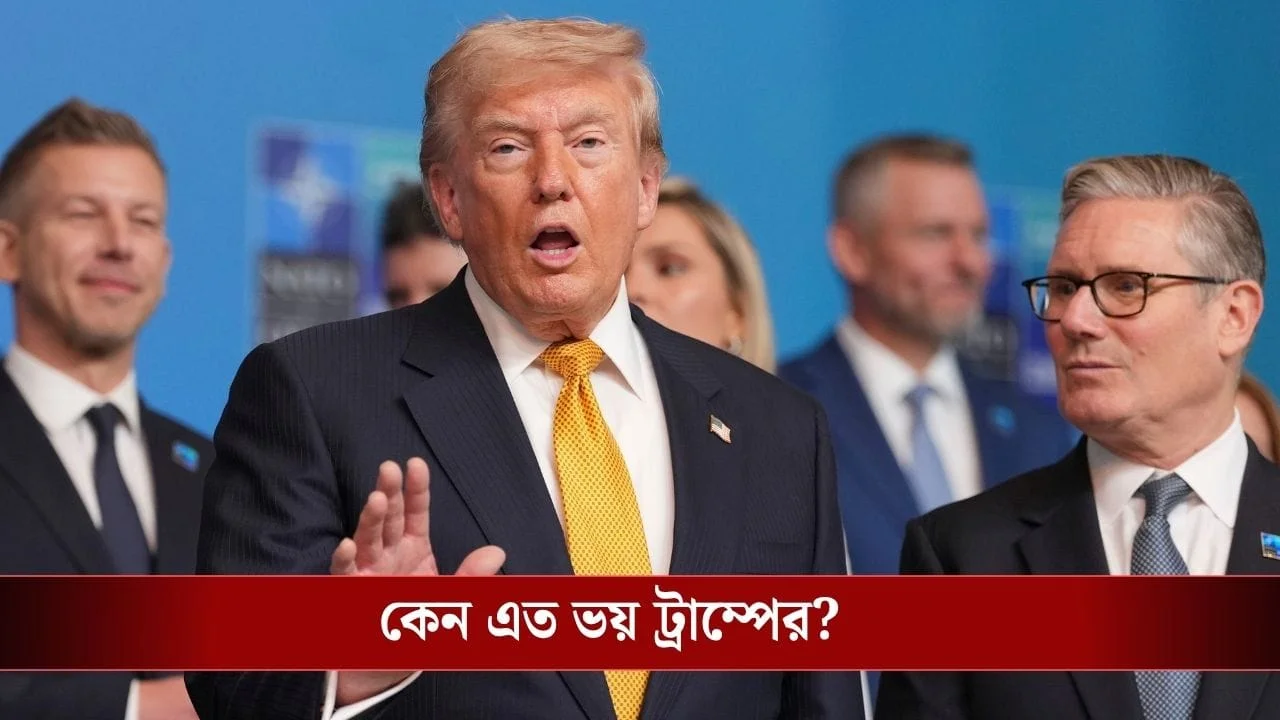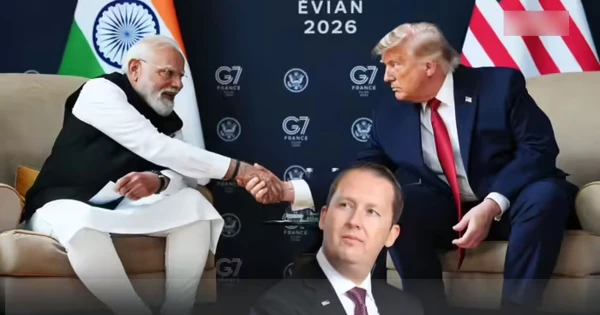
The handshake between President Donald Trump and Indian Prime Minister Narendra Modi at the G7 summit in France marked more than a routine diplomatic greeting. It signaled a serious effort to steady one of Washington’s most important global partnerships.
The two leaders met on June 17 on the sidelines of the G7 summit in Evian-les-Bains, France. It was their first in-person meeting since Modi’s February 2025 visit to Washington, a gap of roughly 16 months.
That long pause came during a turbulent period for U.S.-India relations. Trade disputes, tariff pressure, immigration concerns, Pakistan policy, energy purchases, and regional security tensions had all tested a relationship both governments describe as strategically essential.

The stakes are significant for both countries. The United States and India cooperate on defense, technology, energy, education, maritime security, critical minerals, artificial intelligence, and Indo-Pacific stability. Bilateral goods and services trade has exceeded $200 billion annually.
When Modi visited Washington in February 2025, both leaders launched the U.S.-India COMPACT framework. The initiative aimed to expand cooperation in military partnership, accelerated commerce, and technology, while setting a goal of $500 billion in bilateral trade by 2030.
Early optimism faded quickly. Trade talks slowed as both sides struggled over tariffs, market access, agriculture, dairy, manufacturing, and digital regulations. Washington pushed India to reduce trade barriers, while New Delhi resisted concessions it viewed as politically and economically sensitive.
Relations worsened after the deadly April 2025 terrorist attack in Pahalgam, Jammu and Kashmir. India blamed Pakistan-based militants and later launched military action, leading to the most serious India-Pakistan confrontation in years.
Trump repeatedly said he helped stop the India-Pakistan fighting, a claim New Delhi publicly rejected. India maintained that the halt in hostilities came through direct military channels between India and Pakistan, not through outside mediation.
Washington’s outreach to Pakistan’s military leadership further unsettled Indian officials. At the same time, some figures close to the Trump administration made sharp public comments about India, adding to the diplomatic strain.
Tariffs became another major source of friction. The Trump administration imposed punitive duties on Indian goods, including measures tied to India’s purchases of Russian oil. New U.S. immigration restrictions and steep H-1B visa fee changes also concerned Indian professionals and businesses.
Sergio Gor, Trump’s longtime aide and later U.S. ambassador to India, became one of the most visible figures in the effort to repair ties. His nomination in 2025 gave Washington a trusted presidential channel focused on South Asia.
After Senate confirmation, Gor moved quickly to signal that dialogue remained open. His early public messaging emphasized that disagreements over trade and policy did not erase the broader strategic value of the U.S.-India relationship.
By early 2026, the tone had begun to shift. Trade discussions resumed with greater urgency, tariff pressure eased, and both governments worked toward an interim bilateral trade agreement. Negotiators continued trying to finalize the framework after the G7 meeting.
Technology cooperation also gained momentum. India joined Pax Silica, a U.S.-led initiative focused on secure semiconductor, silicon, artificial intelligence, and critical minerals supply chains. The move strengthened cooperation in areas central to both economic security and strategic competition.
Secretary of State Marco Rubio’s India visit in May 2026 added another layer to the reset. His meetings with Indian leaders and Quad partners reinforced cooperation on trade, defense, energy security, advanced technology, and Indo-Pacific coordination.
At the G7 meeting, Modi raised the safety of Indian seafarers and the importance of keeping the Strait of Hormuz open. The issue carried urgency after the deaths of three Indian crew members during recent Gulf of Oman military operations.
Modi stressed that hundreds of thousands of Indian seafarers work across global shipping routes. For India, protecting civilian maritime crews is tied directly to energy security, trade flows, and the safety of citizens working far from home.
Trump offered strong public support for India and said the United States would help if India came under attack. However, no new formal defense treaty was announced, and the statement remained a political assurance rather than a binding alliance commitment.
The leaders also reviewed progress under the COMPACT framework, including defense cooperation, strategic technologies, energy, and trade. They instructed officials to keep working toward a balanced, commercially meaningful trade agreement as quickly as possible.
For Washington, India remains central to its Indo-Pacific strategy and broader efforts to diversify supply chains away from overdependence on China. For New Delhi, the United States remains a crucial partner in defense modernization, technology access, investment, and global influence.
The Evian meeting did not erase all disputes. Tariffs, visas, Russian energy imports, Pakistan policy, and market access remain difficult issues. Still, the renewed leader-level engagement gave both governments a clearer path to manage disagreements.
Gor’s role underscored the importance of trusted diplomatic channels during periods of political strain. His access to Trump and active engagement with Indian officials helped create space for talks when public rhetoric had hardened.
The G7 handshake ultimately represented a cautious but meaningful reset. Whether the improvement lasts will depend on signed trade progress, steady security cooperation, and the ability of both capitals to keep strategic interests above short-term disputes.