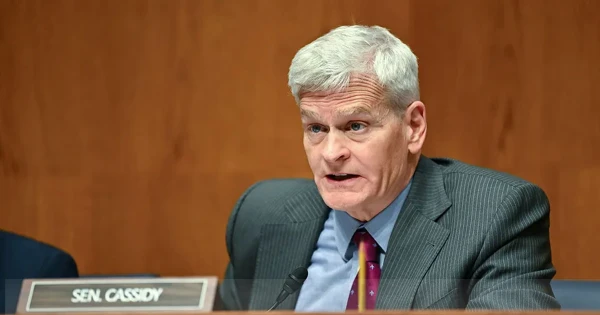
Senator Bill Cassidy, the Louisiana Republican who lost his primary reelection bid, is making a last-ditch effort to address Social Security's impending funding crisis before his term ends in January 2027.
Cassidy has proposed a $1.5 trillion investment fund designed to shore up the program's finances without immediate tax increases or benefit cuts . His plan comes as the Social Security trustees' latest annual report projects the retirement trust fund could be exhausted by the fourth quarter of 2032 .
The proposal, which Cassidy has dubbed his "big idea," would create a separate fund that invests borrowed money in the stock market over a 65- to 70-year period . According to Cassidy, this approach could cover approximately 60 to 65 percent of Social Security's unfunded liability .

The urgency is clear. If Congress fails to act before the trust fund depletion date, beneficiaries would face an automatic 22 percent reduction in their scheduled benefits . The trustees' report moved the projected insolvency date earlier than previous estimates, intensifying pressure on lawmakers .
Cassidy's political clock is ticking. He lost his May primary to Representative Julia Letlow, who received an endorsement from President Donald Trump . The senator's relationship with Trump has been strained since Cassidy was one of seven Republican senators who voted to convict the president during his impeachment trial following the January 6, 2021, Capitol incident .
"I'm a retiring, so to speak, senator," Cassidy said in a recent interview. "I want to get it done before we leave, so there is impetus to get it done" .
The proposal has attracted bipartisan attention, with Cassidy working alongside Democratic Senator Tim Kaine of Virginia, as well as retiring Senate Minority Whip Dick Durbin of Illinois and outgoing Republican Senator Thom Tillis of North Carolina . The four senators issued a joint statement on June 10 calling on colleagues to "legislate on hard issues and protect this lifeline program for our kids and grandkids" .
How the 'Big Idea' Would Work
Cassidy's plan draws inspiration from reforms enacted to the federal Railroad Retirement system under President George W. Bush, which allowed pension funds to invest in private securities . The senator argues this approach improved that program's solvency on a bipartisan basis.
Under the proposal, the federal government would borrow $1.5 trillion over five years and place it in an escrow account to be invested in equities . According to Cassidy, this would not increase the nation's debt because the money would remain in government possession .
The investment would be allowed to grow for 65 to 70 years before being used to offset Social Security's unfunded liabilities . Cassidy maintains that all investment risk would be borne by the fund, with beneficiaries receiving their promised benefits regardless of market performance .
However, the plan has drawn significant skepticism from experts and analysts. The Center for Retirement Research at Boston College recently analyzed the proposal and concluded it is "unlikely to work," noting it would leave the government indebted in the 75th year and require large interest payments . The researchers suggested that such an investment strategy could only succeed if paired with immediate tax increases or benefit cuts .
The Bipartisan Policy Center has also raised concerns about how financial markets would respond to a significant increase in federal borrowing at a time when the national debt is already on an unsustainable trajectory . The think tank also noted that leveraged investment strategies involve "significant risk" given the unpredictability of future stock market returns .
Critics Question Financial Viability
Some experts have compared the proposal to pension obligation bonds, a controversial strategy used by underfunded state pension systems . Critics argue that the plan essentially amounts to borrowing money to play the markets, a risky bet that could leave taxpayers with substantial debt .
Alicia Munnell, director of the Center for Retirement Research, wrote that while equity investment in Social Security trust funds could make sense, the Cassidy-Kaine proposal introduces new risks and avoids addressing the program's fundamental imbalances . She noted that unlike successful models such as the Railroad Retirement Investment Trust or Canada Pension Plan, the Cassidy-Kaine proposal relies on borrowed funds rather than tax revenues or employee contributions .
The Bipartisan Policy Center has pointed out that investing some trust fund revenue in equities rather than Treasury securities would have required the government to issue additional debt, increasing the publicly held national debt by approximately 4 percent . The analysis did not account for potential effects on interest rates and investment returns .
What Comes Next
Cassidy has indicated the next steps include holding more hearings on his proposal and drafting legislative text . He acknowledged that even if his plan succeeds, it would still leave a remaining 35 percent funding gap that would need to be addressed .
"If it doesn't pass this Congress, I am speaking to colleagues who will be here next Congress and seeing who's interested in kind of carrying the torch," Cassidy said .
Senator Durbin, who is also retiring at the end of his term, has called for Congress to actually debate and vote on Social Security legislation. "We have to do something we haven't done in a long time," Durbin said during a Senate floor speech. "Get ready. Buckle your seatbelts. I'm talking about legislating, actually bringing a measure to the floor and opening it to amendment" .
Cassidy remains undeterred by the political obstacles or the skepticism from policy experts. "We need to put the politics aside for the good of the country, for at least a little bit," he said. "That's a challenge before members of Congress right now" .
The senators elected this fall will be in office when the Social Security trust fund is projected to run out in late 2032 . The cost of any potential fixes gets more expensive the longer lawmakers wait, according to experts .
Cassidy's relationship with the White House may complicate his proposal's prospects. President Trump recently called the senator a "disloyal disaster" on social media . The White House has not commented on Cassidy's plan .
Despite these challenges, Cassidy is pressing forward with what he sees as a necessary solution to prevent millions of retirees from facing devastating benefit cuts. The senator's proposal, while controversial, has succeeded in keeping Social Security reform on the national agenda at a time when the program's long-term viability faces its most serious test in decades.