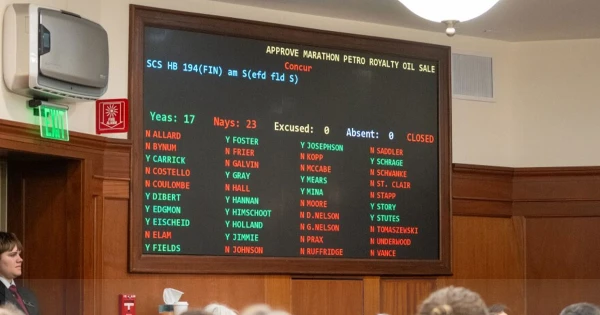
A growing chorus of Alaskans is questioning whether the state’s tax breaks for the oil and gas industry are undermining the very foundation of its economy. As state legislators consider new tax incentives for major energy projects, critics argue that policies enacted over the past decade have shifted the financial burden away from wealthy corporations and onto struggling public services.
The debate centers on three key issues: Senate Bill 21 (SB 21), the S corporation tax loophole, and a proposed 90% property tax waiver for the Glenfarne Group’s liquefied natural gas (LNG) project. Proponents of these tax breaks argue they are necessary to attract investment and keep Alaska competitive in the global energy market. However, opponents contend that these generous concessions are giving away the state’s resources for pennies on the dollar.
Before the passage of SB 21 in 2013, Alaska operated under a tax regime that funded a wide array of public goods. Revenue from oil taxes supported the creation of the Alaska Permanent Fund, the construction and maintenance of new schools and roads, and a student loan program that incentivized graduates to remain in the state by forgiving up to half their loans . Additionally, the state offered robust retirement plans for teachers and public employees and established a Renewable Energy Fund. .

Advocates of oil tax reform note that, for a time, Alaska saw substantial returns from its resource wealth. Under the previous tax structure, known as ACES (Alaska’s Clear and Equitable Share), the state collected approximately $19 billion in production taxes over five years . After the implementation of SB 21, the state reportedly collected zero in production taxes over the subsequent five-year period . This sharp decline in revenue has coincided with a precipitous drop in state savings, from $16 billion to near zero .
The SB 21 law, originally proposed by a former ConocoPhillips lawyer, passed by a single vote in the Alaska Senate after being introduced by the governor . It has since resulted in significant reductions in state oil tax revenue, with estimates suggesting a cost of $8.9 billion in foregone revenue through fiscal year 2025 . The law offers tax credits up to $8 per barrel of production, which some legislators argue are effectively state subsidies for oil company operations on federal land, from which Alaska receives no royalty income .
Another point of contention is the S corporation loophole, which allows certain major players in the oil and gas industry to avoid paying state corporate income taxes. Unlike C corporations like ConocoPhillips and Exxon, which are subject to the state’s corporate income tax, S corporations are exempt. Since Alaska has no personal income tax, these entities pay no equivalent state tax .
This loophole became a more acute issue after a Texas-based billionaire’s company purchased BP’s Alaska assets. This entity, now a primary producer in Cook Inlet and on the North Slope, pays no state corporate income tax despite being one of the largest players in Alaska’s energy sector . Critics highlight that this company is the primary supplier of natural gas to Southcentral Alaska, yet contributes zero dollars to the state general fund through corporate income taxes .
Legislative efforts to close the S corporation loophole have gained traction, with data showing widespread public support. Polls indicate that 77% of Alaskans support requiring these companies to pay corporate income tax, including two-thirds of Republicans . The Department of Revenue estimated that closing the loophole could bring in over $100 million annually through 2030—revenue that lawmakers could direct to schools, infrastructure, and other essential services .
The current legislative session has also seen a push by the governor to grant Glenfarne Group a 90% waiver on property taxes for its proposed LNG pipeline project, which is estimated to cost between $44 billion and over $65 billion . The governor has argued that this property tax break is the final piece needed to transform the decades-long dream of a North Slope gas pipeline into a reality . However, the request has triggered alarm among local officials who rely on property tax revenue to fund schools and public safety.
Critics argue that the state should not give away such a substantial portion of its tax base. Some have noted that the developers stated just a year prior that the project was economically viable without such a massive handout, leading to accusations that the company is overplaying its hand . Furthermore, while Glenfarne has reportedly expressed a willingness to pay corporate income taxes once the pipeline is operational, the governor’s current proposal would drastically cut upfront property taxes .
Concerns are also growing about the timeline of the project. Developers initially suggested that gas would be flowing by 2028 or 2029, but they are now requesting a deadline extension to 2037 for the tax break to remain in effect . This mismatch between promises and the demands for concessions has fueled skepticism about the project’s viability and the true cost to Alaskans.
Ultimately, the debate in Juneau reflects a fundamental question about the state’s future: whether the primary benefit of Alaska’s natural resources should flow to the corporations extracting them or to the Alaskans who own them. As the legislature debates these issues, residents are watching closely to see if their elected officials will prioritize public services or private profits.