



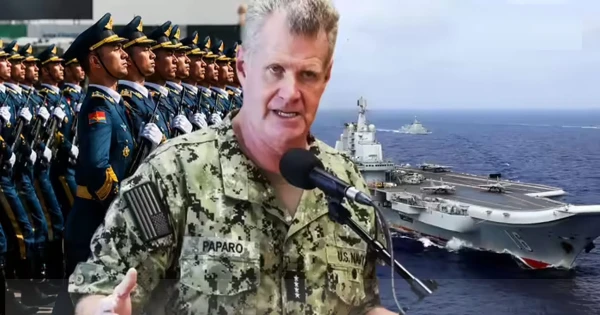
Admiral Samuel Paparo, commander of U.S. Indo-Pacific forces, told U.S. lawmakers that rising tensions with China require an immediate, large-scale upgrade of American military capabilities across the region. He requested roughly $122 billion to buy new weapons, sensors, and systems he said are needed to deter conflict and preserve regional stability.
Paparo characterized the security environment in the Indo-Pacific as increasingly dangerous, saying the risk of crisis or conflict is growing as China modernizes and expands its military. He described the People’s Liberation Army’s long-term expansion as “historic,” and said Beijing has two central military objectives: preparing to seize Taiwan and degrading the defensive capabilities of the United States and its allies.
The request presented to Congress breaks the total into specific capability priorities, according to details the commander provided. About $67.4 billion was identified for missiles and related strike systems, emphasizing long-range precision munitions to hold opposing forces at risk. Another $18 billion was earmarked for systems to counter and defeat Chinese military command-and-control capabilities through electronic and cyber measures.
B-52 Crash at Edwards AFB: What the 2026 Stratofortress Accident Reveals About an Aging Bomber Fleet

Admiral Paparo also asked for roughly $15 billion to expand space-based missile-warning systems and theater-wide surveillance sensors. These capabilities are intended to improve early warning, tracking, and cueing of defensive missions across vast ocean and littoral areas. A further $2.3 billion was proposed for maritime and ground drones to strengthen persistent surveillance, reconnaissance, and strike options in contested areas.
The assessment presented by Paparo is an independent operational view of what his command believes is necessary to maintain deterrence and resilience across the Indo-Pacific theater. The U.S. Department of Defense and Indo-Pacific Command have not released a joint public version of the plan, and lawmakers are reviewing the budget request as part of broader defense appropriations deliberations.
Paparo’s appeal comes after the Pentagon shortened the operational name of his command to “U.S. Pacific Command,” reflecting oversight from the U.S. West Coast to the Indian subcontinent. That geographic responsibility spans vast sea lines of communication, contested island chains, and multiple U.S. treaty partners and partners in the region.
In describing China’s military modernization, Paparo said Beijing has pursued rapid capability development across air, sea, missile, space, and electronic warfare domains, while also deepening cooperation with Moscow and Pyongyang. He warned that these dynamics increase the complexity and risk faced by U.S. forces, raising the bar for readiness, survivability, and interoperability with allies.
Paparo asserted that acquiring advanced communications, intelligence, surveillance and reconnaissance systems, and electronic warfare tools will be critical to blunt any aggression, deny hostile operations near allied territory, and for U.S. forces to operate effectively from contested forward locations. He also suggested that the procurement mix could include advanced electronic warfare suites, hypersonic-capable defenses and counters, and enhanced long-range strike and sensing platforms.
The admiral emphasized deterrence as the primary goal: strengthening the ability to respond credibly to threats so that conflict can be prevented. He told Congress the requested investments would improve persistent sensing, faster decision cycles, and more survivable force posture across the theater, thereby reducing incentives for adversaries to escalate.
U.S. lawmakers now face weighing Paparo’s request against broader fiscal priorities and differing views on how best to deter Beijing’s actions without prompting escalation. Congressional hearings and staff reviews will determine if and how much of the proposed $122 billion is funded, and over what timeframe procurements would be executed.
The debate over these investments comes amid increased diplomatic and military activity across the Indo-Pacific, including exercises, port calls and multilateral planning among U.S. allies and partners. How Congress responds will shape the near-term trajectory of U.S. force posture and capabilities in a region many strategists identify as the most consequential for global security in the coming decade.