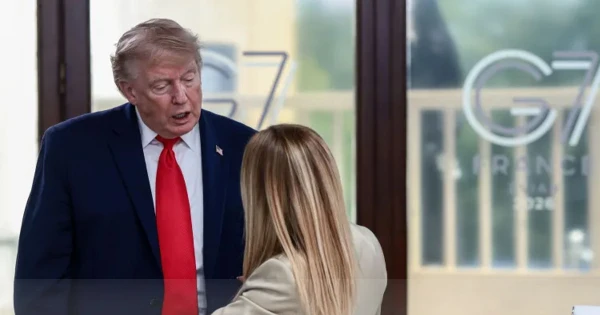
Italian Prime Minister Giorgia Meloni sharply rebuked U.S. President Donald Trump after he suggested she had begged to be photographed with him during the recent G7 summit in France, prompting Rome to cancel a planned ministerial trip to Washington and intensifying a diplomatic rift between the two allies.
The dispute began after an audio excerpt of an interview aired in which Trump described a group photo moment at the Evian-les-Bains summit as one in which Meloni allegedly begged to be included. The president’s comment, presented by the broadcaster in an Italian-dubbed version of the interview, drew an immediate and forceful denial from Meloni, who called the account “completely fabricated” and expressed astonishment that the U.S. president would treat an allied leader in that way.
In a video posted online, Meloni said she was “clearly surprised” by Trump’s remarks and stressed that “Italy never begs.” Her statement underscored a broader discomfort in Rome about the tone of the exchange and its potential impact on bilateral relations between Italy and the United States.

Italy’s foreign minister, Antonio Tajani, announced that a planned trip to the United States on June 21–22 would be canceled in light of the controversy. The foreign ministry described Trump’s comments about Prime Minister Meloni as “serious and objectionable,” saying they had provoked anger across Italy and that the country expected its partners to show mutual respect.
The public spat followed months of both collaboration and strain between Meloni and Trump. Meloni was the only European head of government to attend Trump’s 2025 inauguration, and she has been viewed by some as a bridge between Washington and Brussels. But tensions have risen recently over several issues, including differing reactions to geopolitical developments and a separate dispute involving remarks about the pope and criticism of Iran.
At the G7 summit, the two leaders briefly engaged in efforts to smooth over disagreements, but the situation quickly shifted after media accounts of the photo incident surfaced. European Council leaders at the summit tried to diffuse the moment with light-hearted exchanges; one senior EU official joked that Trump and Meloni were “friends again.” Those attempts at humor contrasted sharply with the subsequent diplomatic fallout.
Trump’s comments during the interview also included sweeping criticisms of European policy on immigration and energy. According to the broadcast, he called Europe’s immigration approach “a disaster” and dismissed parts of the continent’s renewable energy agenda as failures, warning that unresolved problems could permanently change Europe. Such public critiques of allied policies have contributed to a broader anxiety in European capitals about unpredictable rhetoric from Washington.
Italian officials framed the episode as more than a personal disagreement. The foreign ministry’s cancellation of the Tajani visit signaled that Rome saw the president’s words as damaging to Italy’s dignity and to constructive government-level engagement. The move also highlighted Italy’s desire to respond firmly while preserving channels for diplomacy.
Analysts say the dispute illustrates a recurring tension in transatlantic relations: leaders balancing strategic cooperation with sharply divergent public messaging. Italy remains a key NATO ally and an important U.S. partner on issues ranging from defense to trade, yet episodes like this underscore how interpersonal frictions at the top can spill into formal diplomacy.
For now, both capitals face choices about next steps. Rome must decide whether to escalate further—by postponing other planned contacts or issuing additional formal protests—or to pursue quiet, behind-the-scenes diplomacy to de-escalate. Washington likewise must weigh the diplomatic cost of the president’s public remarks against the strategic benefits of maintaining strong ties with Italy.
Observers note that even amid disputes, the two countries share significant overlapping interests, including security cooperation in Europe and the Mediterranean, economic ties, and collaboration on global challenges. Those shared interests provide incentives for rapid normalization, but they do not eliminate the immediate diplomatic consequences of the latest exchange.
The episode also raises questions about how allied leaders will manage public disagreements going forward. In an era of rapid media amplification and social platforms, offhand remarks and media interviews can have immediate foreign-policy effects, prompting ministers to change travel plans and governments to issue formal statements.
As of now, no high-level U.S. reply to Italy’s cancellation has been made public. Diplomatic officials on both sides may pursue discreet contacts to prevent further escalation and to rebuild trust. Until those steps are taken, the incident will stand as a reminder that personal rhetoric between heads of government can quickly become a matter of international consequence.