


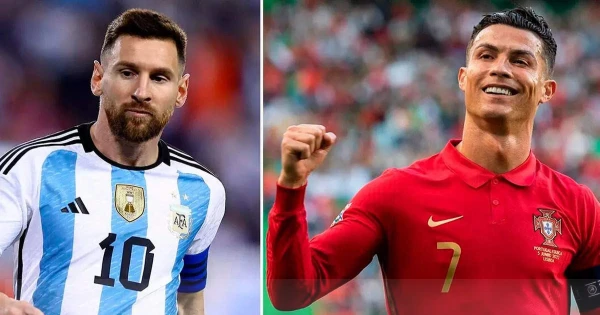
A new multinational study suggests that choosing Lionel Messi or Cristiano Ronaldo as your favorite player may reflect more than a sporting preference — it can also be statistically linked to political ideology. Researchers who surveyed more than 10,000 people across 26 countries report a clear pattern: respondents who favor Messi were more likely to hold liberal political views, while Ronaldo supporters showed a tendency toward conservative views. The paper, carried out by academic teams in Singapore and Spain, analyzed the relationship between football fandom and political identity after controlling for demographic and psychological factors.
The research drew responses from 10,661 participants spanning diverse national, cultural and age groups. Survey questions measured sports preferences alongside a range of variables, including political ideology, age, education, income, personality traits, authoritarian attitudes, self-esteem, media consumption habits and cognitive measures. Political ideology emerged as the strongest predictor of which star a respondent favored even when those other variables were taken into account.
Study findings indicate a consistent correlation: people who identified as politically liberal more frequently selected Messi as their preferred player, and those with conservative leanings were more likely to name Ronaldo. The association held across many countries in the sample, although the magnitude of the link varied by place and by age cohort. Younger respondents showed the most pronounced relationship between player preference and political views; the correlation weakened with age and became statistically negligible among older participants.

Beyond ideology, the authors reported additional psychological and media-related differences connected to player preference. Higher scores on measures of authoritarianism and higher reported self-esteem were associated with greater likelihood of favoring Ronaldo. Increased consumption of short-form video news — social media clips or quick-streaming news formats — also correlated with stronger Ronaldo support. The researchers caution, however, that these factors are part of broader patterns and do not imply deterministic or universal relationships for individual fans.
The paper emphasizes that the results describe population-level trends, not categorical claims about individual supporters. The researchers explicitly note that not every Messi fan is politically liberal and not every Ronaldo fan is conservative. Instead, the associations reveal how cultural figures and political identity can align across groups in measurable ways. The authors situate their work within a growing body of social science that examines how cultural tastes — from music and film to sports allegiances — can reflect and reinforce broader value systems.
Experts in political psychology and cultural sociology have long studied links between taste and identity. This study adds to that literature by focusing on two of the most globally recognizable athletes and by using a large, cross-national dataset. The paper’s cross-country design allowed the team to explore whether the Messi–Ronaldo preference pattern is a localized phenomenon or a more generalizable signal of political orientation. While the pattern surfaced across many countries, its strength and cultural meaning differed depending on national context and local football cultures.
Methodological constraints temper the study’s implications. The data are observational and rely on self-reported measures, which limits the ability to make causal claims. Cultural context, media framing and local football histories can shape how fans perceive players, and these unmeasured forces could influence the observed associations. The sample, though large and geographically broad, does not fully represent every country’s population distribution and may under- or over-represent particular demographic groups in some places. The authors acknowledge these limitations and call for follow-up research to test causal mechanisms and to examine how media, national narratives and social networks shape both sports fandom and political identity.
The research arrives amid an era where celebrity figures and political identities increasingly intersect. Professional athletes, entertainers and influencers often become symbols in broader cultural debates, and supporters can project political meanings onto public figures. The Messi–Ronaldo contrast may reflect deeper narratives: Messi’s low-key, team-oriented persona and origins from Argentina, and Ronaldo’s high-profile, performance-driven image and public branding, can resonate differently with audiences who prioritize community, tradition, status or individual achievement.
Neither Lionel Messi nor Cristiano Ronaldo has publicly responded to the study. Both players remain central figures in global sport, each with huge fan bases, extensive commercial ties and significant cultural influence. For fans, the study offers a statistical lens on a familiar rivalry; for researchers, it opens avenues for exploring how sports preferences intertwine with political and social identities.
As social scientists refine tools to study cultural politics, this research underscores one clear point: seemingly trivial choices — the athlete you admire, the music you prefer, the shows you watch — can carry signals about larger values and beliefs. Recognizing these patterns can help explain how cultural tastes contribute to identity formation and social polarization, while reminding readers that individual choices are shaped by many overlapping factors.