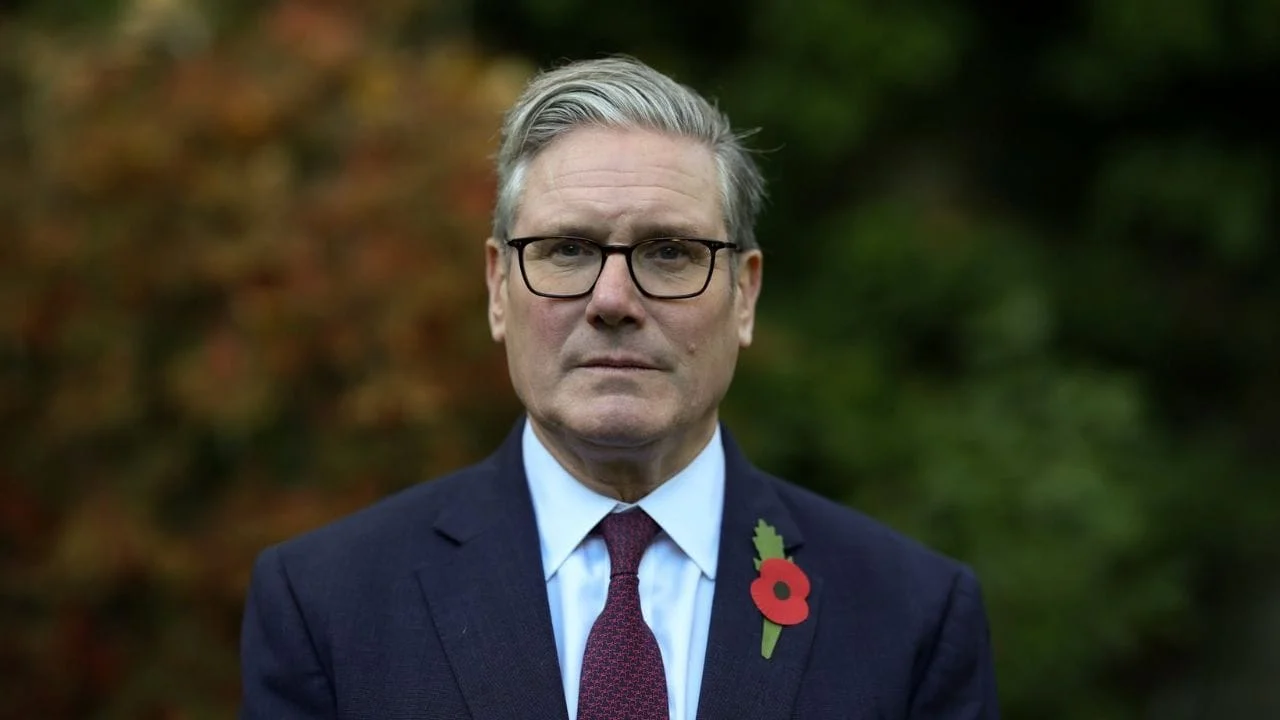
London — In a stunning political development that will reshape Britain's leadership, Prime Minister Keir Starmer officially announced his resignation on Monday, surrendering to mounting pressure from his own Labour Party after less than two years in office. The decision triggers a leadership contest that could see the United Kingdom install its seventh prime minister in just a decade .
Standing outside the iconic black door of 10 Downing Street, a visibly emotional Starmer confirmed he had informed King Charles III of his decision to step down as both prime minister and leader of the Labour Party. His voice cracked with emotion as he addressed the nation, acknowledging that his party no longer believed he was the right person to lead them into the next general election.
“The question my party is asking now is whether I am best placed to lead us into the next general election,” Starmer told assembled journalists and staff. “I have heard the answer of my parliamentary party to that question, and I accept that answer with good grace” .

The prime minister emphasized that his decision was driven by what he believed was in the country's best interest, stating that every choice he made during his tenure was about putting the nation first. He confirmed that nominations for his successor would open on July 9 and close by the summer recess on July 16, with the goal of having a new leader in place before Parliament returns in September .
The Rise of Andy Burnham
All eyes now turn to Andy Burnham, the former Mayor of Greater Manchester, who is widely regarded as the frontrunner to succeed Starmer. Burnham secured his return to Parliament last week with a decisive by-election victory in the Makerfield constituency, winning approximately 55 percent of the vote .
The 56-year-old politician, often dubbed the “King of the North” for his popularity in the region, has already confirmed his intention to put himself forward as a candidate in the leadership contest. In a social media post following Starmer's announcement, Burnham thanked the outgoing prime minister for his service and pledged to seek the party's leadership .
Political analysts suggest Burnham's path to Downing Street could be relatively smooth, as he enjoys deep support within Labour's parliamentary caucus. The question now is whether other candidates will step forward to challenge him or whether the contest will effectively become a coronation .
A Rapid Political Downfall
Starmer's resignation marks a dramatic fall from grace for a politician who, just two years ago, led Labour to a historic landslide victory, ending 14 years of Conservative rule with an impressive 411 seats in Parliament . His victory in July 2024 was achieved on a platform of stability and competence, with Starmer positioning himself as a serious leader for serious times .
However, the prime minister's popularity began to erode almost immediately after taking office. A series of policy U-turns, including the controversial decision to cut winter fuel payments for pensioners and backtracking on pledges to scrap university tuition fees, damaged his credibility with both the public and his own party members .
According to recent polling data, Starmer's approval ratings plummeted dramatically during his tenure. In August 2024, just one month after taking office, only 36% of people thought he was doing well as prime minister. By June 2026, that figure had collapsed to just 18%, with 74% of respondents saying he was performing poorly .
The final blow came from within his own ranks. Following disastrous local and regional election results in May, which saw Labour lose more than 1,400 council seats, discontent among Labour MPs reached a boiling point . More than 100 lawmakers reportedly urged Starmer to set a timetable for his departure .
The Mandelson Controversy
Perhaps the most damaging episode of Starmer's premiership involved his decision to appoint Lord Peter Mandelson as UK ambassador to the United States. The appointment unraveled when new information emerged about the depth of Mandelson's relationship with the late convicted sex offender Jeffrey Epstein .
The scandal, which led to Mandelson's sacking, severely undermined Starmer's promise to restore integrity to British politics and raised serious questions about his judgment and the wider Downing Street operation .
Defending His Record
Despite his political demise, Starmer used his resignation speech to defend his government's achievements. He pointed to progress on employment rights, immigration reduction, investment in healthcare, and efforts to combat child poverty .
“The hard work of change was with a singular purpose – not power for power's sake but to change Britain for the better,” Starmer said, arguing that he had inherited a party that was “politically, financially and morally bankrupt” and transformed it .
The prime minister's tenure did see some notable economic achievements, with the UK economy growing faster than most of the G7 during part of his premiership . However, forecasters predict this growth may not be sustained, partly due to global energy shocks and ongoing geopolitical tensions .
A Personal Moment
In a rare display of vulnerability, Starmer choked up as he spoke about his family, thanking his wife Victoria for her unwavering support through good times and bad. He expressed his desire to spend more time on what he called “the most important job”: being a good husband and father .
“When I leave the biggest job in the country, I shall spend more time on the most important job: being the best husband I can to my fantastic wife Vic,” Starmer said, his voice breaking with emotion .
What Comes Next
As Britain prepares for yet another leadership transition, the country faces significant challenges. The ongoing cost-of-living crisis, sluggish economic growth, and a deeply polarized political landscape await Starmer's successor .
Burnham, if confirmed as the next prime minister, would inherit a party that has been deeply shaken by internal divisions. He will also face a formidable challenge from Nigel Farage's Reform UK party, which has consistently outperformed Labour in national opinion polls .
The nomination process for the Labour leadership will officially begin on July 9, with candidates needing to secure the backing of their parliamentary colleagues to advance . Under Labour's rules, the leader must be a member of Parliament, which Burnham will officially become when he is sworn in as an MP on Monday .
Starmer has pledged to remain as caretaker prime minister until the contest is complete, promising to do everything in his power to ensure an orderly transition of power. He also offered his successor his full and unequivocal support .
A Nation's Political Turmoil
Starmer's resignation adds another chapter to Britain's ongoing political instability, which began with the 2016 Brexit referendum. Since then, the country has cycled through prime ministers at a rate unprecedented in modern British history .
The fact that a prime minister who won a landslide majority just two years ago is now being forced out by his own party underscores the immense difficulties facing political leaders in today's volatile political climate. As analysts have noted, the lack of sustained economic growth and persistent financial constraints continue to make prime ministerial tenures increasingly precarious .
For now, Britain awaits its next leader, with the Labour Party facing a critical decision about its future direction and the country confronting fundamental questions about its political and economic stability.