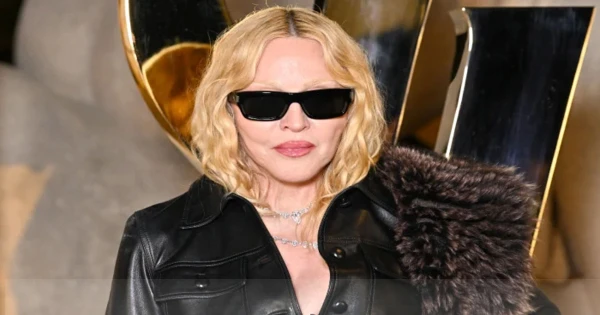
Madonna has finally broken her silence regarding the collapse of her highly anticipated biopic, revealing that the project was ultimately derailed by a significant budget dispute with Universal Pictures.
The pop icon, who spent two years developing the script and an additional two years in pre-production, shared that the studio's inability to meet her financial requirements for a film of this scale led to its complete cancellation.
"I've had an extraordinary life. I've had a huge life, so I needed a big budget," the singer explained during an interview with Interview magazine.

Universal Pictures had won a competitive multi-studio auction in 2021 to produce the film, with Madonna attached to co-write and direct the project.
Several notable screenwriters, including Diablo Cody and Erin Cressida Wilson, contributed to the script over the years, while Julia Garner was cast as Madonna following a widely publicized audition process in 2022.
The film was intended to chronicle the artist's journey from her Michigan upbringing through her rise as an artistic force in 1980s New York, culminating with the 1998 release of her critically acclaimed album Ray of Light.
Madonna proposed filming in Serbia as a cost-saving measure, but the studio responded with skepticism regarding her commitment to the location.
"One of their first reactions was, 'We don't believe you'd stay in Serbia more than four days,'" she recalled.
The singer questioned whether the studio fully believed in her creative vision. "Maybe they just didn't believe in me," she suggested.
When negotiations with Universal ultimately fell through, Netflix approached Madonna about developing the story as a limited series instead.
However, this alternative path also presented significant obstacles, as the rights to the existing script remained with Universal Pictures.
"I could not use the script I had written with Universal without buying it back at an extortionist's price, even though I wrote it," she stated.
The process of starting over with the streaming platform meant searching for a showrunner, a search that dragged on for approximately eight to nine months without yielding a resolution.
"I was like, 'Good thing I have another job because I need to work, I need to create. I need to do what I was put on this earth to do,'" the singer remarked.
Despite these setbacks, a Netflix autobiographical series remains in development through Shawn Levy's production deal with the streaming service.
Julia Garner is not attached to the series version of the project, leaving the casting for that iteration still undetermined.
Interestingly, the story of Madonna's ill-fated biopic has found new life in a fictional form, with the singer and Garner appearing together at the Venice Film Festival for season two of Seth Rogen's Apple TV+ comedy series The Studio.
In that show, a Madonna biopic starring Garner serves as a prominent storyline, offering audiences a satirical glimpse at what might have been.
The project's cancellation highlights the challenges that high-profile artists face when translating expansive, multi-decade careers into a single feature film.
The complexity of condensing such a vast narrative—spanning musical evolution, cultural impact, and personal transformation—proved logistically and financially daunting.
Budget constraints ultimately forced the production into an impossible position, as the scope of Madonna's life story required resources that the studio was unwilling to commit.
The development process, which had generated significant anticipation among fans and industry observers alike, now serves as a case study in creative and financial friction within Hollywood.
Universal's inability to reconcile the scale of Madonna's vision with their budgetary parameters demonstrates the delicate balance between artistic ambition and commercial viability.
The film's cancellation also raises questions about how biographical projects for major cultural figures are prioritized and funded in the current entertainment landscape.
Streaming platforms have increasingly stepped in to fill gaps left by traditional studios, though creative control and intellectual property issues continue to complicate such arrangements.
The Netflix series, while still moving forward, will require new creative direction and likely a completely different approach to storytelling.
For Madonna, who has consistently navigated career pivots and reinventions, the experience represents another obstacle in a lifetime of challenges and survivals.
The artist's reference to her personal resilience underscores the determination that has defined her four-decade career.
As the entertainment industry continues to evolve, the fate of this project serves as a reminder of how economic realities often shape creative outcomes.
Audiences will need to wait and see whether the Netflix series eventually reaches production or if the biopic remains a permanent piece of Hollywood lore.
The fictionalized version appearing in The Studio, however, proves that even as a canceled project, the story continues to capture imaginations.