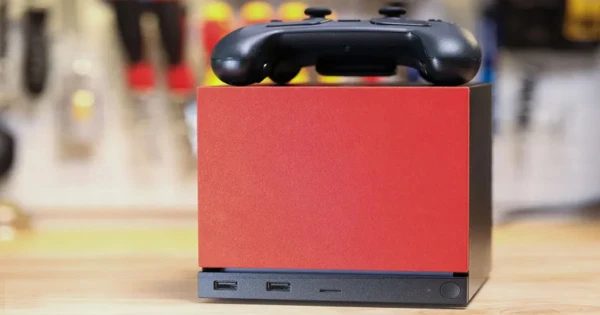
Valve has officially unveiled its highly anticipated Steam Machine, a compact living-room gaming PC that arrives with a starting price of $1,049. While that’s nearly double the cost of a standard PS5, Valve insists it’s selling the console-like device essentially at cost. But with component prices soaring, is Valve’s mini-PC a fair deal, or would gamers be better off building their own rig?
The Steam Machine, which ships on June 30, is a engineering marvel in many ways. The 6-inch cube houses custom AMD silicon, including a six-core Zen 4 mobile processor and an RDNA 3-based GPU with 8GB of VRAM, along with 16GB of DDR5 RAM . However, due to severe memory shortages, Valve was forced to use a single-channel RAM configuration, which can cause performance bottlenecks in memory-intensive titles . The device is available in 512GB and 2TB storage configurations, with prices ranging up to $1,428 when bundled with a Steam Controller .
Despite its diminutive size, the Steam Machine delivers respectable 1440p performance in demanding titles. Real-world testing shows it runs Cyberpunk 2077 at around 72 FPS with FSR enabled, while Red Dead Redemption 2 hits 85–95 FPS at similar settings . However, the device struggles with ray tracing, and titles like Horizon Zero Dawn Remastered average just 58 FPS at 1080p .

The big question on many gamers' minds is whether they could save money by building a comparable PC themselves. The answer, according to component analyses, is a resounding “not really.” Independent hardware experts have pieced together similar Mini-ITX builds using off-the-shelf parts, and the numbers tell a compelling story. A DIY system with comparable performance using a Ryzen 5 8400F CPU, RX 7600 GPU, and a compact Fractal Design Terra case totals approximately $1,269—over $200 more than Valve’s base model . More conservative estimates place a 512GB equivalent build at around $930 to $979, offering only marginal savings of about $70 to $100 . For the 2TB model, the value proposition tilts further in Valve’s favor, with a DIY build costing around $1,139 versus Valve’s $1,349 price—a $211 difference .
However, building your own PC brings important trade-offs. Off-the-shelf Mini-ITX systems are significantly larger than the Steam Machine’s 6-inch cube, and replicating Valve’s custom cooling solution and motherboard design is virtually impossible . The Steam Machine also runs silently, a feat that’s hard to match with standard PC components . For those willing to pay a premium for size and quiet operation, the Steam Machine’s compact form factor is a key selling point .
The pricing strategy has not been without controversy. The $1,049 base model is more expensive than Sony’s PS5 Pro, which costs $899 and offers superior graphical performance thanks to its advanced PSSR upscaling technology . Performance comparisons show the Steam Machine generally matches the base PS5, with its CPU outperforming Sony’s console in processor-bound scenarios like Crimson Desert, but falling behind in GPU-intensive titles . PC gamers can also build a more powerful system for the same price, though it won’t be as compact .
Valve has acknowledged the pricing challenges, pointing to a turbulent hardware market. In a recent blog post, the company revealed that RAM and storage prices have risen significantly since development began in 2023, and there were periods when it “couldn’t source some of our components at all, at any price” . This has impacted both pricing and launch-day availability.
For gamers on the fence, Valve is offering a compelling alternative: SteamOS 3.8 is now available for free, allowing users to build their own Steam Machine with any AMD-based PC . This DIY route offers more flexibility and potentially better performance, though it lacks the Steam Machine’s sleek, compact design.
Ultimately, the Steam Machine presents a paradox: it’s a surprisingly fair deal given current component prices, but its value depends entirely on what gamers prioritize. Those seeking a quiet, tiny living-room PC with seamless Steam integration will find few alternatives at this price point. Meanwhile, gamers looking for raw performance or maximum value may find Sony’s PS5 or a traditional PC build more appealing. As pre-orders open on June 25, the market will decide whether Valve’s gamble pays off .