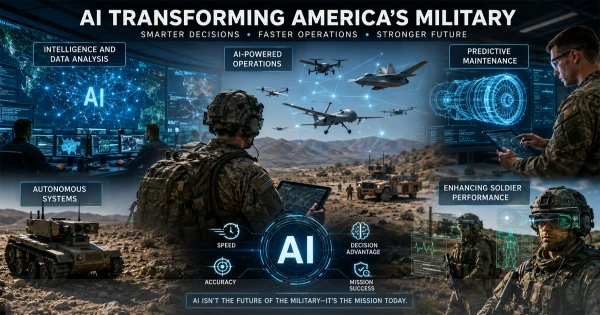
Artificial intelligence is reshaping America’s military from the inside out, changing how the Pentagon gathers intelligence, plans operations, maintains equipment, and supports troops in the field. What was once a promising experiment is now a core part of modernization, with military leaders treating AI as a way to move faster, make better decisions, and keep pace with rivals in a data-driven era.
A New Military Advantage
For the U.S. military, AI is less about science fiction than speed, scale, and accuracy. Defense officials say the technology can help commanders understand the battlefield faster, identify threats sooner, and turn information into action with less delay. That shift matters because modern conflict is increasingly shaped by who can process the most data and make the best decisions first.
The Pentagon’s push reflects a broader recognition that military strength is no longer measured only in ships, aircraft, and troop numbers. It also depends on software, computing power, and the ability to connect sensors, analysts, and decision-makers across a vast defense network.

Where AI Is Already Working
AI is already being used across several parts of the defense enterprise, not just on the battlefield. It is helping analysts sort drone footage, support predictive maintenance, improve logistics, and streamline enterprise operations that used to rely on slower human workflows. In practical terms, that means AI can reduce downtime for aircraft, flag unusual activity in intelligence feeds, and help units plan supply needs more efficiently.
Some of the most important uses include:
-
Intelligence analysis, where machine learning tools can scan massive volumes of imagery and signals data.
-
Predictive maintenance, where algorithms look for warning signs before equipment fails.
-
Logistics and sustainment, where AI helps forecast parts demand and transport needs.
-
Command and control, where software supports faster situational awareness and decision-making.
-
Cyber defense, where automated systems can detect suspicious patterns at machine speed.
These applications may sound technical, but the effect is concrete: fewer delays, better targeting of resources, and more time for humans to focus on judgment rather than raw data processing.
The Pentagon’s Strategy
The Defense Department has made AI adoption an official priority, not an optional upgrade. Its strategy emphasizes decision superiority, resilient sustainment, and faster kill chains while also calling for stronger data management, interoperable infrastructure, and more digital talent. More recently, the Pentagon announced an AI acceleration strategy aimed at cutting bureaucratic barriers and making AI more widely available across military functions.
That institutional shift matters because defense technology often moves slowly unless leadership forces change. The new approach is designed to speed experimentation, shorten procurement cycles, and give smaller teams room to test useful tools without waiting years for approval. In other words, the military is trying to adapt its culture to the pace of commercial AI development.
Why Speed Matters
On a modern battlefield, a few minutes can change everything. AI helps compress the time between detecting a threat, interpreting it, and responding to it. That can improve everything from air defense to battlefield logistics, especially when commanders are dealing with complex, fast-moving situations.
Still, speed is not the same as wisdom. Defense analysts note that AI can be powerful at pattern recognition, but it can struggle when conditions change, data becomes messy, or adversaries deliberately try to deceive it. That is why military planners continue to emphasize human oversight, especially in decisions involving force and lethal action.
Human Control Still Matters
One of the biggest questions surrounding AI in the military is not whether it works, but how much authority it should have. The U.S. has long maintained that humans must remain in the chain of command, even as AI becomes more deeply embedded in battlefield systems. That principle is central to responsible use, especially when lives are at stake.
This concern is not abstract. Military AI can assist with target identification, but it can also produce false positives or miss context that a trained human would catch. The danger is not just technical failure; it is overreliance, where people trust the system too much and stop questioning its outputs.
The Ethics Question
As AI becomes more capable, ethical concerns become harder to ignore. Critics worry about autonomous weapons, mass surveillance, bias in algorithms, and the possibility that faster decision-making could lower the threshold for conflict. Supporters argue that responsible AI can improve precision and reduce human error, but only if strict rules govern how it is used.
The Pentagon says it wants AI to be reliable, secure, and aligned with military values, but that balance is difficult to maintain in practice. Systems must be tested for accuracy, protected from manipulation, and monitored for unintended consequences. That means AI governance is becoming as important as AI innovation.
What It Means for Troops
For service members, AI is likely to change daily work in both visible and invisible ways. It may reduce tedious paperwork, improve maintenance planning, and help commanders allocate manpower more efficiently. It may also give frontline units better awareness of what is happening around them, especially when operating in cluttered or contested environments.
At the same time, troops will need new training. Working alongside AI means understanding what the system can do, where it fails, and when to override it. The military’s long-term challenge is not simply buying better software; it is building a force that knows how to use it wisely.
The Competitive Pressure
America is not developing military AI in a vacuum. Defense officials see the technology as central to maintaining an edge in a security environment shaped by rapid innovation and global competition. That pressure explains why the Pentagon is pushing faster adoption and broader integration across the services.
But strategic advantage is not guaranteed. The side that deploys AI first may gain speed, yet the side that trains better, governs more carefully, and adapts more intelligently may hold the stronger advantage over time. In that sense, military AI is not just a technological race; it is a test of discipline, judgment, and execution.
The Road Ahead
Over the next several years, AI will likely become even more embedded in American defense operations. The most durable changes will probably be less dramatic than autonomous robots on the battlefield and more practical than that: better logistics, better intelligence processing, faster maintenance, and more informed command decisions. Those are the quiet upgrades that can shape outcomes in a real conflict.
The central lesson is straightforward. AI is transforming America’s military by making it faster, more data-driven, and more adaptive, but its success depends on clear rules, strong oversight, and human accountability. The technology may be new, but the core challenge is old: using power wisely.