The 2026 FIFA World Cup is the largest World Cup ever, with a new 48-team format and an expanded knockout bracket that changes how fans, pundits, and bracket predictors plan picks and projections; understanding the bracket now helps U.S. viewers follow the tournament and make smarter predictions for pool play or bracket games. The bracket affects millions of fans and bettors, tournament organizers, broadcasters, and health-minded viewers who plan watch parties or travel. Keep reading for a complete, step-by-step guide to how the 2026 bracket works, how to build a bracket predictor, and practical strategies for U.S.-based audiences.
What the 2026 bracket is
-
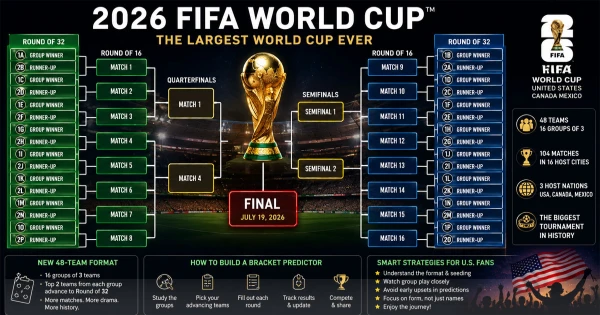
The 2026 World Cup expanded the field to 48 teams, grouped into 12 groups; the knockout stage features a round of 32 rather than a round of 16.
-
The knockouts include 12 group winners, 12 runners-up, and the eight best third-placed teams, making the bracket larger and fixed in advance so teams can see potential paths to the final.cbssports
-
Bracket maps and live brackets are maintained by major sports outlets and FIFA’s own bracket challenge tools, which let fans predict group outcomes and knockouts.

Why the 2026 bracket matters
-
Tournament structure directly shapes match importance and rest days, which affects team health, injury risk, and player load management — matters fans and health-conscious viewers should know.cbssports
-
For brackets and prediction games, the larger field increases variance (more upsets and longer paths), changing optimal prediction strategies versus past World Cups.cbssports
-
Broadcasters, advertisers, and travel planners use bracket scheduling to plan programming and events across the U.S., Canada, and Mexico host cities.foxsports
How the bracket is determined (the rules)
-
Groups: 48 teams split into 12 groups (A–L). Top two teams from each group qualify automatically for the knockouts.wikipedia
-
Best third-placed teams: The eight third-place teams with the best records across all groups advance; tie-breakers follow FIFA rules (goal difference, goals scored, etc.).
-
Fixed bracket: There is no redraw — the bracket is predetermined after group stage placements are decided, meaning each group's placing maps to a specific round-of-32 match.cbssports
Bracket anatomy — rounds and progression
-
Round of 32: 32 teams (12 group winners, 12 runners-up, 8 best third-place) in single-elimination matches.cbssports
-
Round of 16, Quarterfinals, Semifinals, Third-place match, Final: traditional single-elimination progression from 32 down to champion.
-
Schedules and match locations are fixed across the three host countries, which influences travel and recovery times.foxsports
Bracket predictor basics — what fans need
-
Bracket format: Most predictors ask users to select group winners/placements, then pick knockout winners across the bracket. FIFA and independent sites run bracket challenges.
-
Scoring systems: Predictors use points per correct pick, often weighted more heavily for later rounds; understand scoring before finalizing picks.cup-predictor
-
Data sources: Use seeding, FIFA rankings, recent form, injury reports, and head-to-head history to inform picks; major sports sites provide up-to-date bracket pages and live results.
Building a strong bracket predictor — step-by-step
-
Start with group-stage probabilities:
-
Use FIFA rankings and recent results to estimate which teams are likely to finish first, second, or third in each group.wikipedia
-
-
Model third-place advancement:
-
Because eight third-place spots advance, model the probability distribution of third-placed teams across groups rather than assuming a specific nation advances.cbssports
-
-
Account for rest and travel:
-
Host-country locations and travel routes matter for teams’ recovery time between matches; prioritize teams with favorable geography when predicting late-round success.foxsports
-
-
Weight later rounds:
-
Many bracket games allocate more points for quarterfinals and up, so focus on reliable picks in the knockouts rather than extreme long-shot upsets early on.cup-predictor
-
-
Use ensemble approaches:
-
Combine expert picks, statistical models, and crowd predictions (public bracket consensus) to reduce single-model bias.cup-predictor
-
Bracket strategy and psychology
-
Conservative vs. contrarian: A conservative bracket follows seeding and favorites, maximizing chances of predicting deep runs, while contrarian brackets seek differentiators for head-to-head pools.cbssports
-
Account for variance: Bigger tournament means more opportunities for surprise third-place qualifiers and Cinderella runs; diversify picks if competing in many pools.cbssports
-
Pool rules matter: Score rules (e.g., bonus multipliers for upsets) change optimal strategy; always read the contest’s scoring.cup-predictor
Health and viewing considerations
-
Match scheduling and recovery: Fans planning watch parties should note U.S. time zone match placement and travel demands for attendees; prolonged late-night viewing can affect sleep and work schedules.foxsports
-
Crowd safety: Large gatherings and stadium attendance require attention to hydration, sun protection, and local public health guidance.foxsports
-
Mental stress: For heavily invested fans, bracket outcomes can cause disappointment; practice balanced viewing habits and social connection to reduce stress.
Common bracket pitfalls to avoid
-
Ignoring third-place mechanics: Many fans forget the significance of the eight best third-place teams — modeling only winners and runners-up will miss key scenarios.cbssports
-
Overvaluing rankings: FIFA ranking is useful but not definitive — consider injuries, form, and matchup styles.wikipedia
-
Blindly following favorites: Upsets are more likely with 48 teams; an unexpected third-place qualifier can open a path for underdogs.cbssports
Tools and resources (where to run predictors)
-
FIFA’s bracket challenge and predictor feature lets fans build official brackets.play.fifa
-
Sports sites (ESPN, FOX Sports, CBS, NBC Sports) provide interactive brackets, live updates, and analysis.
-
Independent predictor sites and community pools add social competition.cup-predictor
Example bracket predictor workflow (simple practical example)
-
Step 1: Fill group finish predictions using rankings and recent friendlies.
-
Step 2: Simulate third-place ranking scenarios to see which third-placed teams likely advance.
-
Step 3: Project round-of-32 matchups and assign probabilities for each knockout pairing.
-
Step 4: Optimize picks for your contest scoring (e.g., maximize expected points across rounds).
-
Step 5: Submit the bracket and monitor updates for injuries or late changes.
Metrics to track for better predictions
-
Team form (last 10 matches), goal differential, injuries, travel burden, head-to-head, and coaching stability.
-
Public consensus—if many brackets pick the same upset, the value of picking it in a pool may be lower.cup-predictor
Common myths vs. facts
-
Myth: FIFA ranking guarantees knockout success. Fact: Rankings matter but are one factor; group composition and matchups often override ranking.wikipedia
-
Myth: Always pick favorites to win the tournament. Fact: With more groups and third-place qualifiers, contrarian deep runs are more plausible in 2026 than prior tournaments.cbssports
-
Myth: Bracket predictors are purely luck. Fact: Combining data-driven models and expert insight improves long-term performance.cup-predictor
Products That May Help
-
Fitness trackers for managing sleep during late matches.
-
Accurate digital clocks and world-time apps to track kickoff times.
-
Ergonomic seating and blue-light filters to reduce strain during late-night viewing.
-
Basic first-aid kits and hydration packs for stadium outings.
-
Portable battery packs and travel organizers for multi-city viewing plans.
Key takeaways
-
The 2026 World Cup bracket is larger and more complex, with 48 teams and a round of 32 knockout stage driven by group winners, runners-up, and the eight best third-placed teams.
-
Predictors should model third-place advancement, account for travel and rest, and adapt strategy to scoring rules.
-
Use official FIFA tools and reputable sports sites for live brackets and updates.
FAQ (5–8 SEO-friendly questions)
-
How does the 2026 FIFA World Cup bracket work?
-
The 2026 tournament expanded to 48 teams across 12 groups; the knockout stage includes 32 teams made up of group winners, runners-up, and the eight best third-placed teams in a fixed bracket.
-
Where can I build a FIFA World Cup 2026 bracket predictor?
-
Use FIFA’s bracket challenge, or third-party sites and sports outlets such as ESPN, FOX Sports, CBS, and independent bracket websites.
-
How should I pick third-place teams for my bracket?
-
Model probabilities based on group strength, goal difference expectations, and past regional performance; simulate outcomes rather than picking arbitrarily.cbssports
-
Do third-place teams often advance far in the tournament?
-
It’s less common for third-place qualifiers to reach the final, but with more third-place spots in 2026, the chance for surprise deep runs increases compared with prior formats.cbssports
-
What’s the best strategy for bracket pools?
-
Understand scoring, weight later rounds appropriately, mix conservative and contrarian picks based on pool size, and track public consensus to decide where to differentiate.
-
Where are round-of-32 matches played in the U.S.?
-
Matches are distributed across host cities in the U.S., Canada, and Mexico; consult official schedules on sports outlets for specific venues and kickoff times.foxsports
-
When is the bracket finalized?
-
The bracket positions are determined after group-stage matches conclude, once group winners, runners-up, and the eight best third-placed teams are known.